



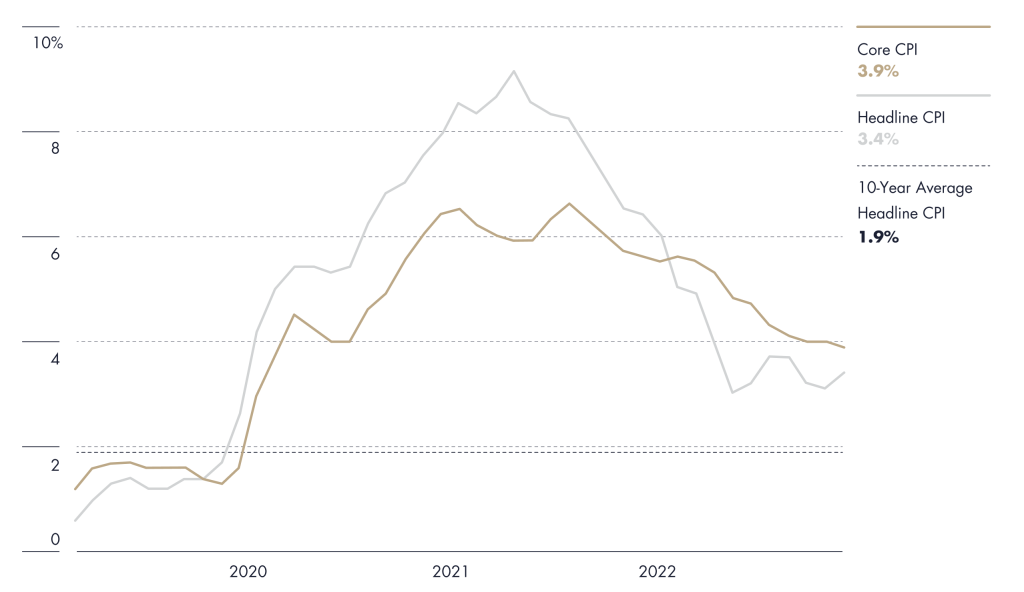
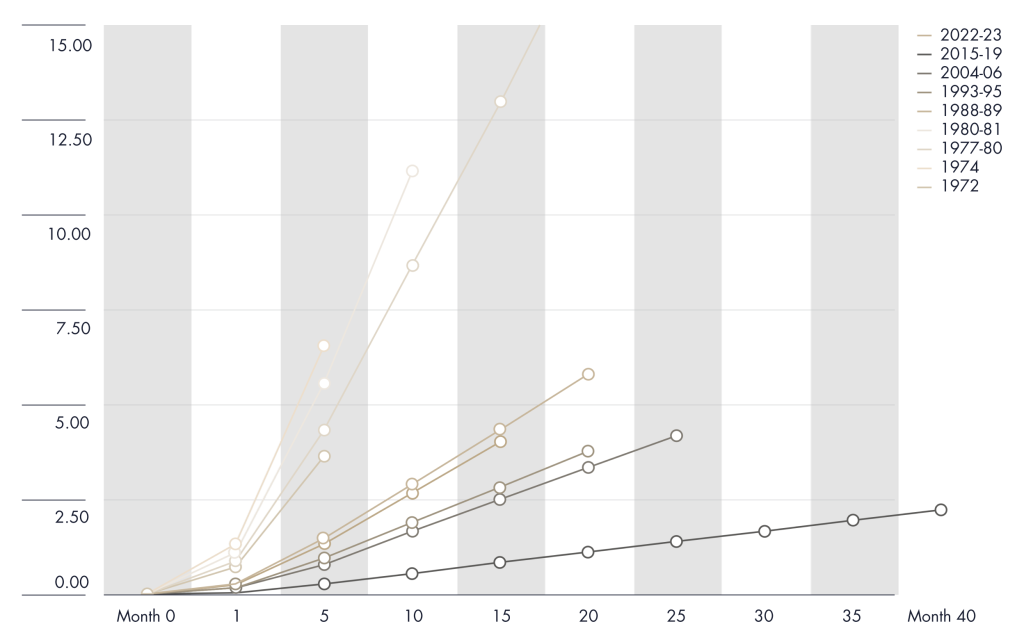
High interest rates continued their fight against inflation over the course of the fourth quarter with inflation rates inching closer to central bank target ranges. As illustrated in the graph below, Core and Headline CPI in the United States have fallen drastically since peaking in June 2022 (See graph below), following one of the most aggressive monetary policy tightening cycles in recent times (See second graph below).
CPI VS CORE CPI
Source: Morningstar Direct.
CURRENT MONETARY POLICY TIGHTENING CYCLE IS FASTEST AND STEEPEST SINCE 1980-1981
Source: Morningstar Direct.
Given the high interest rate environment it would be expected that GDP growth would come grinding to a halt. However, economies around the world showed their reliance to falling into recessions owing largely to dramatic supply-side improvements, this included clearing of bottlenecks affecting specific industries (energy and autos) as well as general improvement in labour supply and productivity.
EQUITY REVIEW
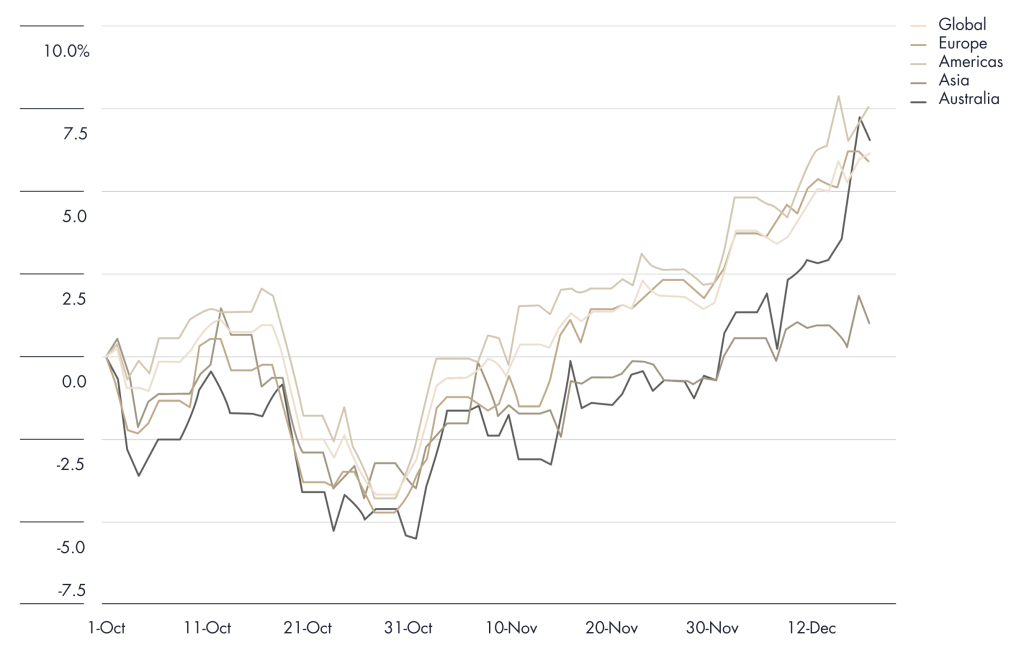
The continued downward trend in inflation fuelled investors’ belief that the interest rate hike cycle is over and provided optimism of rate cuts in 2024. In addition, the continued strength of economies provided evidence that a soft landing could be a reality. Therefore, as per the graph below, equity markets were a great place to be in the fourth quarter (Asian equities aside).
MSCI ACWI AND MSCI EMERGING MARKET INDICES
Source: Morningstar Direct.
The MSCI ACWI and MSCI Emerging Market Indices gained 11.0% and 7.9% over the fourth quarter respectfully and 22.2% and 9.8% over 2023 (Total Return measured in USD).
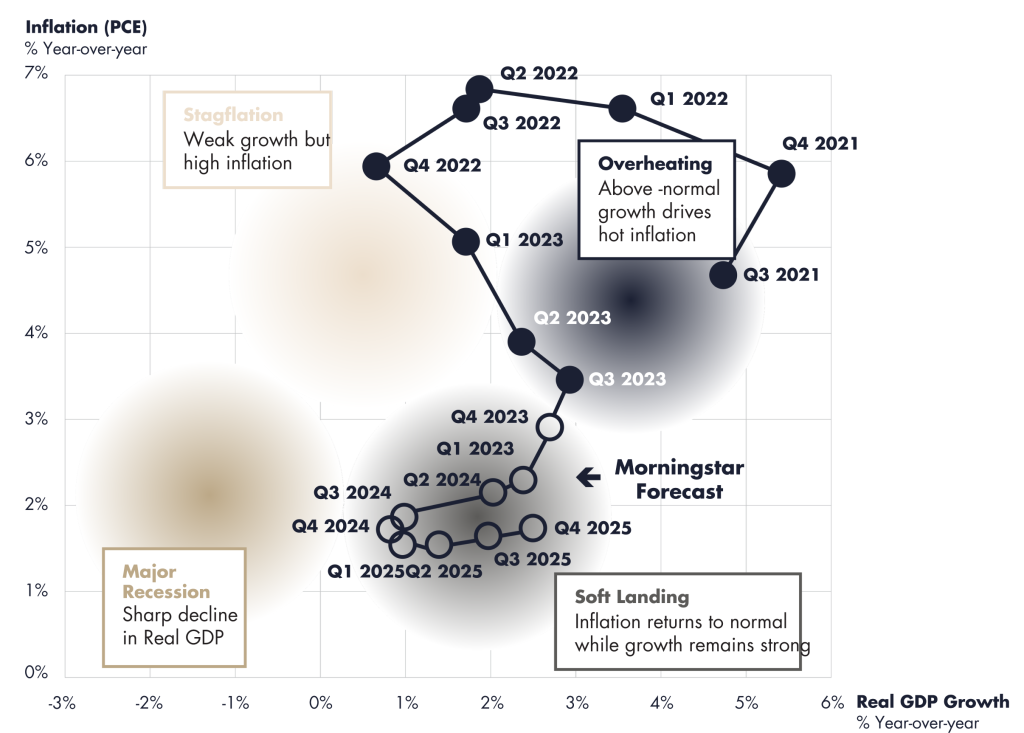
The below graph perfectly illustrates the tightrope that Central Banks have had tread over the past 18 months in trying to balance taming inflation whilst not suffocating GDP growth. According to forecasts, it is predicted as this stage that we’re heading for a soft landing which we believe is the most probable outcome, given the easing of supply constraints as well as the stimulus Central Banks now have at their disposal.
INFLATION VS GDP GROWTH SCENARIOS
Source: Morningstar Direct.
An interesting point to note is the unusual concentration of the equity market rally over the course of 2023. The magnificent seven (Google, Apple, Microsoft, Amazon, Tesla, Nvidia and Meta Platforms) accounted for nearly 62% of the total return of the S&P 500 and managed an eyewatering average return of 104.7% over the course of 2023.
However, Tesla, Google and Amazon ended 2023 below their closing price at the end of 2021. Only Apple, Microsoft and Nvidia managed to outperform riskless one-month US treasury bills, which returned 3.2% per year between 2021 and 2023. Therefore, a portion of the staggering returns achieved by these companies is a result of the large drawdown in 2022, leading to a low base at the beginning of 2023.
FIXED INCOME REVIEW
Following a difficult 2022, fixed income markets have largely normalised and rebounded in 2023. With the Bloomberg Global Aggregate Bond Index gaining 8.1% over the quarter (Total Returns measured in USD). Expectations that Central Banks are finished with hiking interest rates and optimism around possible interest rate cuts in 2024 fuelled the fixed income market during the fourth quarter. However, it has been an unusually bumpy ride with uncertainty regarding Monetary Policies and the ability of high interest rates to tame inflation shifting yields. Fixed income returns over the course of 2023 were positive as measured by the 5.7% gain in the Bloomberg Global Aggregate Bond Index with those bonds with a credit spread outperforming treasuries (Total Return measured in USD).
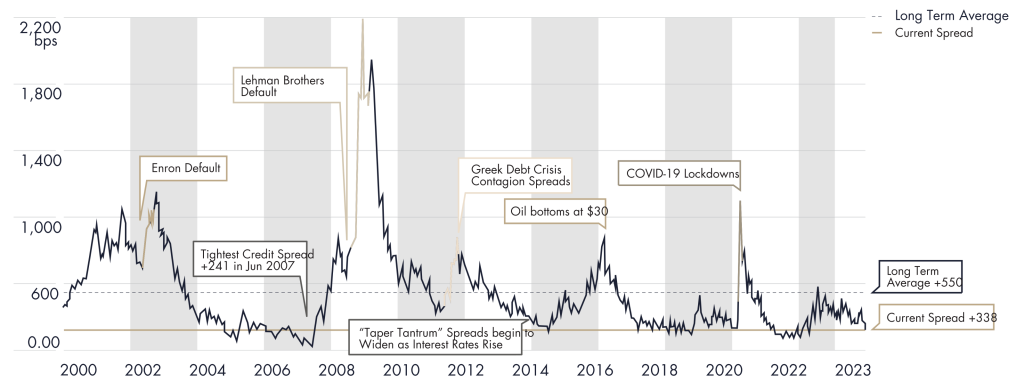
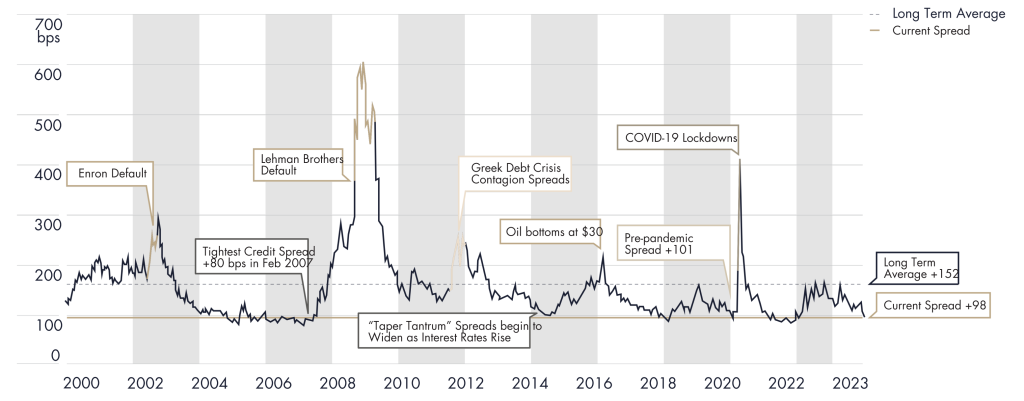
Corporate credit spreads tightened over the fourth quarter. In the investment grade corporate bond market, the average spread of the Morningstar US Corporate Bond Index tightened 18 basis points and average spread of the Morningstar US High-Yield Index tightened 63 basis points. Over the past 23 years, only 15% of the time has the spread on the Morningstar US Corporate Bond Index been below the current spread. Over the same period, only 12% of the time has the spread on the Morningstar US High-Yield Bond Index been below its current spread.
MORNINGSTAR US CORPORATE BOND INDEX AVERAGE CREDIT SPREAD
Source: Morningstar Direct.
Although a soft landing looks like the more probable economic outcome over the course of 2024, should the higher interest rates have a greater impact on economies than currently anticipated it is clear that credit spreads would need to adjust upward from their current historically low levels.
MORNINGSTAR US HIGH YIELD BOND INDEX AVERAGE CREDIT SPREAD
Source: Morningstar Direct
REAL ESTATE REVIEW
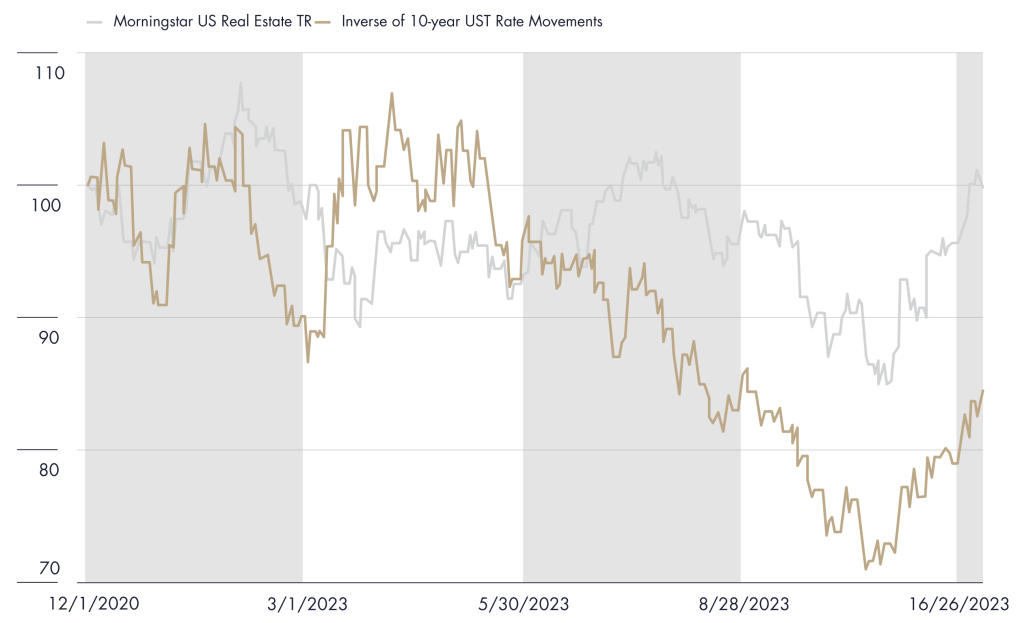
The fourth quarter was positive for global property with the FTSE Global Property REIT Index gaining 15.2% over the quarter and pulling performance for the year to 9.6% (Total Return measured in USD). The continued downward trend of inflation and the resilience shown by economies boosted performance of an asset class that had largely struggled over the first nine months of 2023 owing largely to continued interest rate increases. As illustrated in the graph below, Between July and October, rates on the 10-year U.S. Treasury climbed from 3.75% to almost 5% and the real estate sector saw a 15% decline in share prices over that timeframe. However, since mid-October 10-year U.S. Treasury rates have fallen to around 4.2% and real estate share prices have rallied back 15% in that period.
SINCE JULY, REAL ESTATE INDEX MIRRORED INVERSE OF INTEREST-RATE MOVEMENTS
Source: Morningstar Direct.
SOUTH AFRICA REVIEW
Locally, the macroeconomic backdrop remains tentative with positive developments on inflation and the possible end of interest rate hikes clouded by a lack of economic growth (predicted Real GDP growth rate of 0.93% in 2023), uncertain government finances and structural issues such as power crises and infrastructure limitations. This difficult macroeconomic environment resulted in weak relative performance of South African equities with the FTSE/JSE All Share gaining 6.9% over the quarter and 9.3% over 2023 (Total Return measured in ZAR). Courtesy of cheap valuations at the start of 2023, as well as the softening global interest rate environment, the FTSE/JSE All Bond Index delivered a return of 8.1% over the fourth quarter and 9.7% in 2023 (Total Return measured in ZAR). 2024 could prove to be a pivotal year in the South African political landscape with the general elections later this year being the most uncertain in recent times with the ANC losing a majority vote and notoriously unstable coalitions becoming more of a possibility.
In addition to the difficult economic and political environment facing South Africa, global risk aversion over most of 2023 resulted in the Rand depreciating against major currencies over the past year, with the Rand losing 7.5% against the US Dollar, 11.5% against the Euro and 13.7% against British Pound.
CONCLUSION
2023 proved to be strong year for most asset classes, which was contrary to majority of expectations at the beginning of 2023. This highlights the importance of ensuring your portfolio is always positioned in alignment with your risk tolerance and long term investment objectives and avoid making allocation adjustments based upon expectations of market movements in the short term.
