



As global inflation cools and with interest rate shifts on the horizon, the outlook for risk-on assets like emerging markets has become increasingly positive. The high valuations in the US further support a potential resurgence in emerging markets, promising significant rewards for patient investors over the next decade.
At Bellamont, we believe that incorporating emerging markets into a balanced portfolio is crucial. This article explores the recent performance and some of our insights into the benefits of investing in emerging markets and why the current global macroeconomic environment makes now an opportune time to invest in this dynamic region.
EMERGING MARKETS – FORGOTTEN GEMS
The last decade has been relatively difficult for emerging markets which as per the MSCI Emerging Markets index posted an annualised return of just 0.2% for the decade ending in June 2024. This pales in comparison to the lofty returns posted by developed markets over the same period which gained 7.5% per annum as per the MSCI Developed Markets index.
A large influence behind the performance of developed markets has been the strength of the United States, which now represents 68% of developed market-capitalisation. A cohort of phenomenally profitable, fast-growing companies have dominated. Apple and Microsoft’s share prices are both up by a factor of 10 since 2014. Amazon is up nearly 7 times, Meta more than 5, and Alphabet roughly 4.
It was not so long ago that the roles were reversed. From 2002 to 2014, emerging markets equities produced an annualised return in excess of 10%. The asset class boomed, especially between 2003 and 2007. The US Federal Reserve’s move to slash interest rates in 2003 was undoubtedly part of the story, unleashing capital flows and a risk-on market mode. China’s turbocharged economic growth fuelled a “commodity supercycle,” with demand for resources like iron ore, gold, and oil lifting many emerging markets.
A TALE OF TWO DECADES – EMERGING VS DEVELOPED MARKETS

Source: MSCI. Data as at 30 June 2024. Reflected in USD.
UNDER ALLOCATION
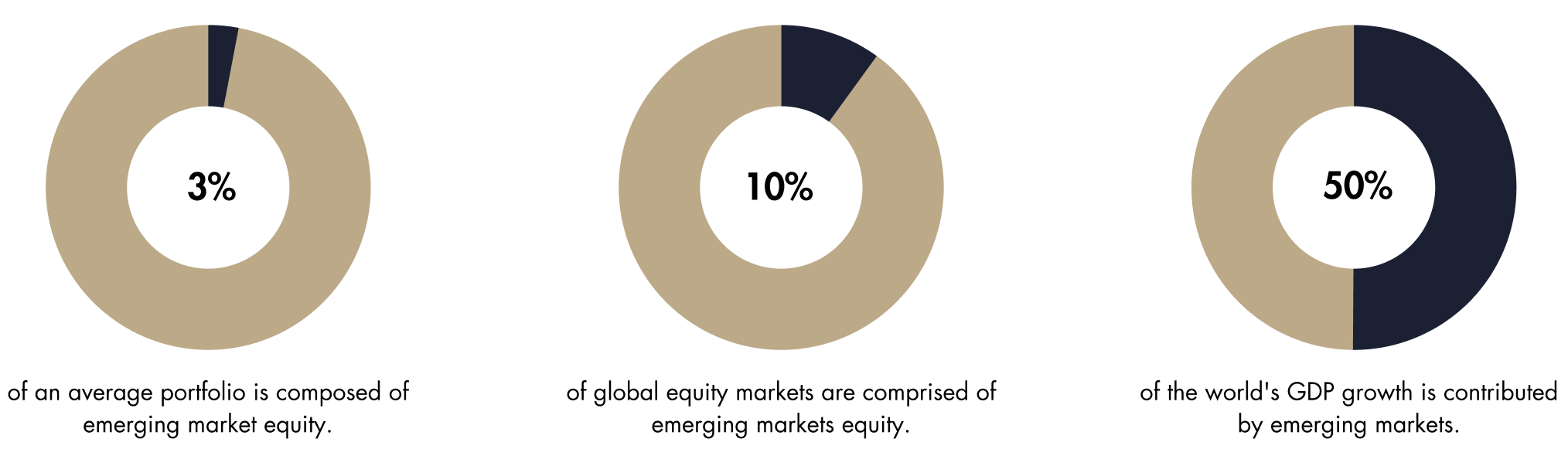
The sustained period of underperformance of emerging markets relative to developed markets as well as an aversion the unfamiliar has likely resulted in an under allocation to emerging markets. Emerging markets represent approximately 80% of the world’s population and over 50% of the world’s GDP, but only 10% of the total global equity market capitalisation. Additionally, the average portfolio is composed of 3% emerging markets equity
Source: World Bank, MSCI. Data as at 30 April 2024.
DARKEST BEFORE THE DAWN
Historically, emerging markets have shown a cyclical pattern where a strong decade is often followed by a weaker one relative to developed markets. However, over the long term, emerging markets have typically outperformed, gaining more in strong periods than they lose in weaker ones. Despite significant setbacks in the past 10 years (as shown in the table to the right), emerging markets are poised for a powerful rebound, echoing Winston Churchill’s famous quote: “The pessimist sees difficulty in every opportunity. The optimist sees opportunity in every difficulty.”
A TALE OF TWO DECADES – EMERGING VS DEVELOPED MARKETS

Source: MSCI. Data as at 30 December 2022. Reflected in USD.
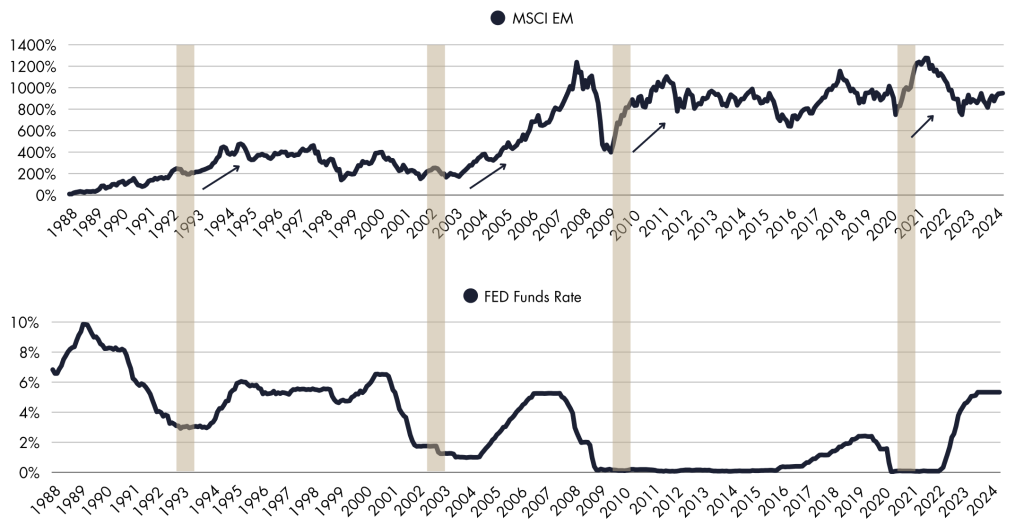
Analysing the total returns over the past five years and comparing them to the expected returns over the next five years (based on dividend yield, expected growth, and expected valuation change) reveals an interesting outlook. These figures suggest that the US may face a challenging few years ahead, while emerging and frontier markets offer compelling returns. However, these are only expectations, and the only certainty is that the US has shown considerable outperformance, whereas emerging, frontier, and developed markets excluding the US remain relatively inexpensive. Only time will tell who the eventual winners will be in the next cycle, but as always, there are opportunities for savvy investors.
GLOBAL EQUITIES – CAPITAL MARKET ASSUMPTIONS
Source: London Stock Exchange Group. Data as at 31 May 2024. Reflected in USD.
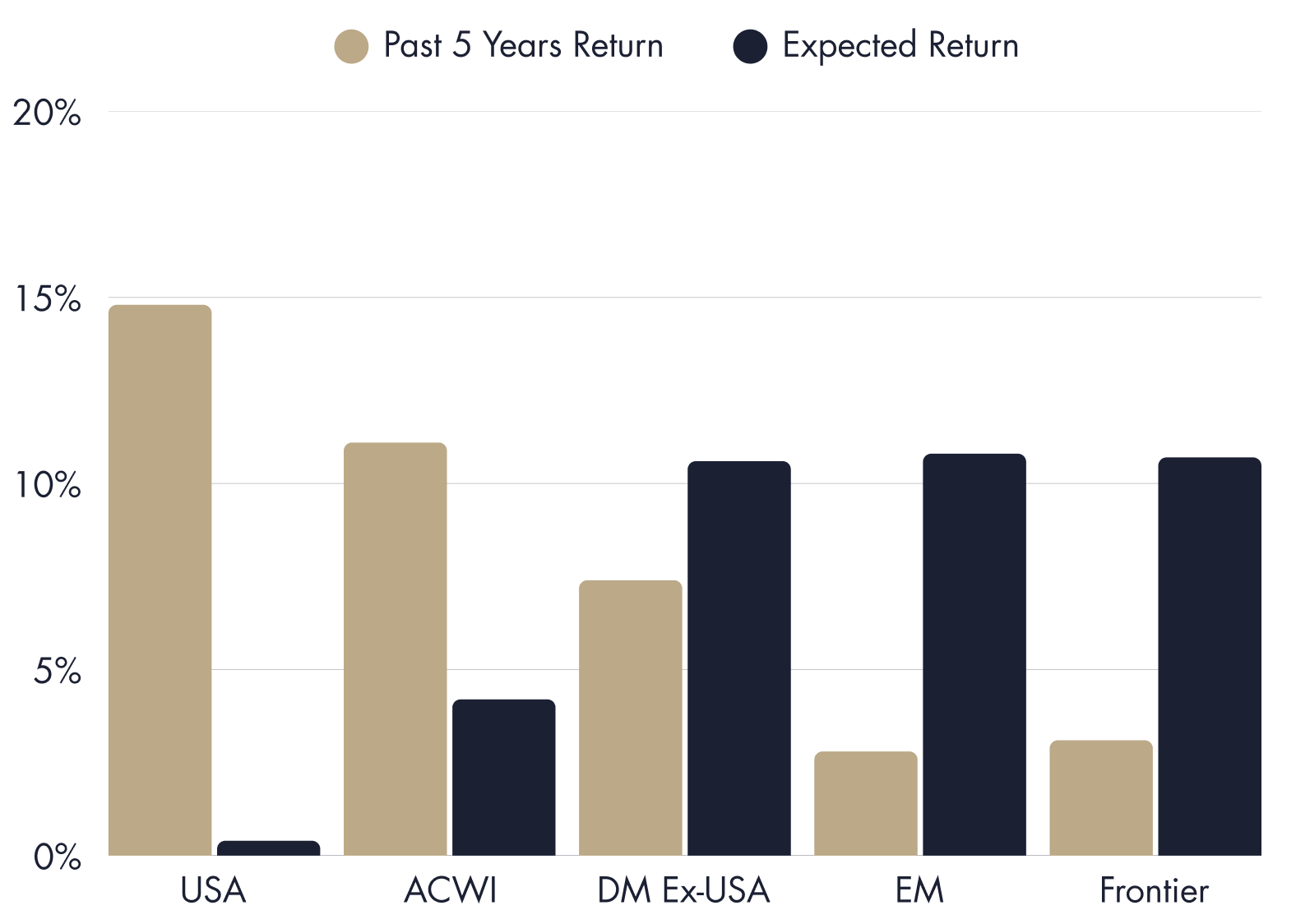
Based upon the above, it appears that emerging markets are primed for some outsized returns. Examining history reveals that lowering of interest rates by the US Federal Reserve has had a positive impact on emerging markets, as evidenced by the highlighted bars on the graphs on the following page. Policy shifts make borrowing cheaper, encouraging investment and economic growth in these regions. The graphs clearly illustrate the resulting uptick in economic activity and market performance in emerging markets following rate cuts by the Fed. Current expectations are for three to four interest cuts by the US Federal Reserve before the end of 2024 which as indicated above and by the graphs below bodes very well for emerging markets.
DARKEST BEFORE THE DAWN
Source: MSCI. Data as at 30 June 2024. Reflected in USD.
CONCLUSION
Emerging markets have undoubtedly been through a particularly difficult period, with investors not being adequately rewarded for over fourteen years. However, as highlighted in this article, there are numerous reasons to remain optimistic about investing in this region.
We at Bellamont believe that emerging markets should always form a part of a global balanced portfolio and that the current global macroeconomic environment, coupled with suppressed returns for an extended period, makes this region particularly attractive for investors. As Wayne Gretzky said, ‘Skate to where the puck is going, not where it has been.’
We have recently published a research paper on emerging markets, detailing some of the more pertinent reasons behind our current optimism towards this region. This paper is available on our website for those interested in a deeper dive.
