



Please find below the latest monthly commentaries from Sifter Capital and Cullen Capital, the underlying investment managers of the Bellamont BCI Global Equity Feeder Fund and Bellamont BCI Emerging Markets Feeder Fund respectively. The commentaries provide insight into portfolio positioning, key market developments, and the underlying managers’ latest views on global markets and company fundamentals.
Bellamont BCI Global Equity Feeder Fund
In parternership with

Broad-based gains across the portfolio
During April, many of our core holdings reported record Q1 results.
Earnings growth is not slowing down: it is supported in particular by AI-related investments, demand for cloud services, and the recovery of the semiconductor supply chain. We also expect industrial companies to participate more fully in the growth as activity strengthens more broadly in the real economy.
The effects of the Iran war have not yet faded, although the market is currently pricing the risk fairly calmly. We have not changed the portfolio’s composition, but we are monitoring the situation closely and are prepared to act if needed.
Top 3
4/2026 / Total return in EUR
- Texas Instruments +42.2%
- BE Semiconductor +39.0%
- Alphabet +31.4%
Bottom 3
4/2026 / Total return in EUR
- Tomra Systems -14.5%
- Johnson & Johnson -7.7%
- North West Company -5.3%
Earnings growth accelerated across our largest holdings
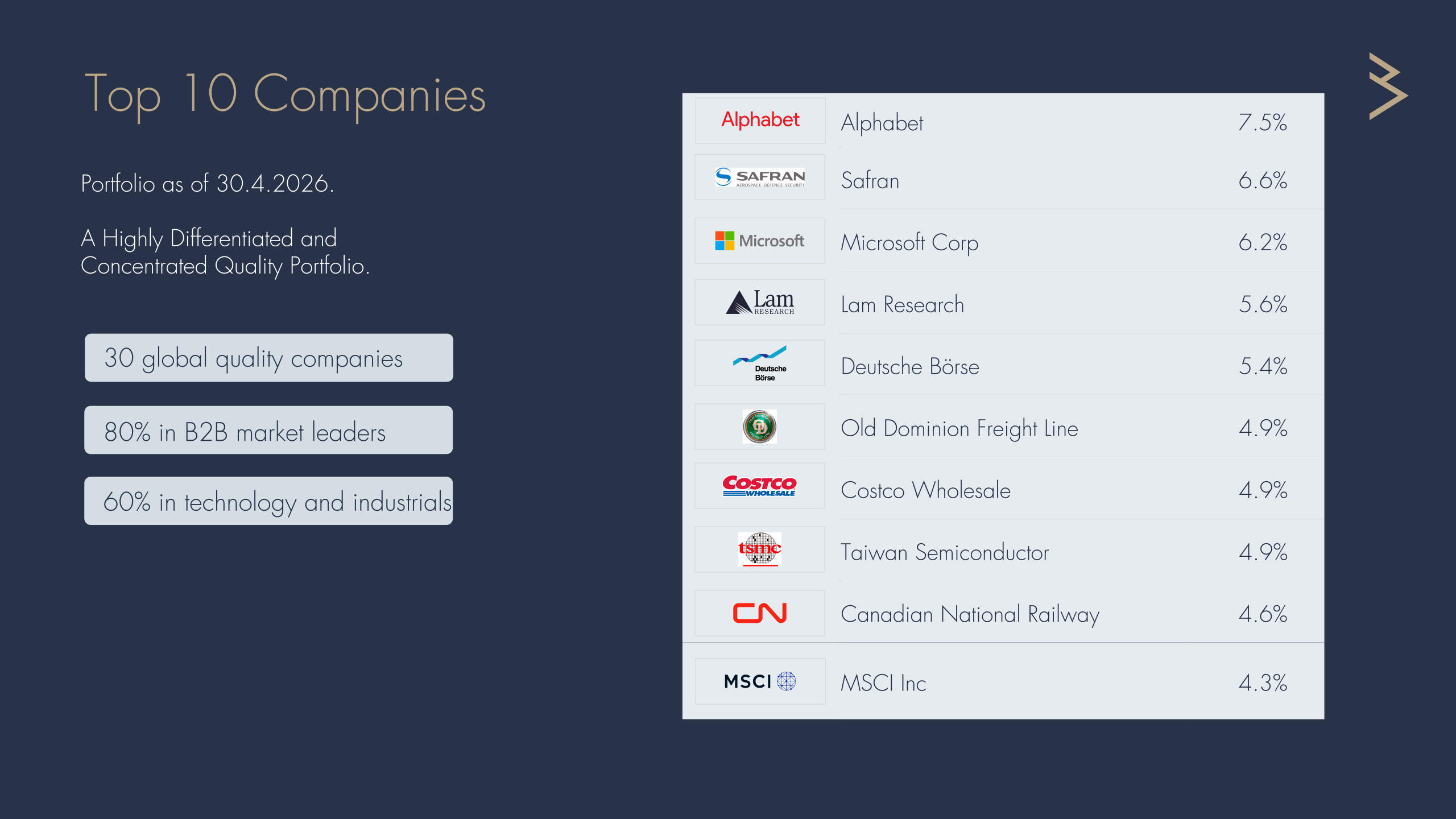
The Sifter Fund’s four largest holdings are different in nature, but they share one common feature: strong business growth.
Alphabet reported a very strong quarter. Revenue grew 22% and Google Cloud grew 63%. The company’s strong advertising business, the rapid growth of its cloud services, and the adoption of AI show that AI is no longer just an investment story: it is starting to show in earnings as well.
Microsoft’s revenue grew 18%, with Azure and other cloud services up 40%. Microsoft is investing heavily in AI infrastructure, which raises capital expenditure in the short term but, in our view, strengthens the company’s long-term competitive advantage. We added to our Microsoft position in both February and April, when the share price relative to long-term earnings expectations looked attractive to us.
Safran continued to perform strongly. Q1 revenue grew 19%, driven by civil aviation, LEAP engine deliveries, and aftermarket services in particular. A long order book and a large installed base make Safran’s cash flows predictable and high-margin.
Lam Research’s revenue grew approximately 24% year-over-year. Gross margin was around 50% and operating margin 35%. The company benefits directly from rising AI investments in the semiconductor industry, and the recovery in demand is starting to show in profitability as well.
Multiple growth engines drove the largest gainers
April’s strong return did not come from a single company. The largest contribution came from Alphabet, whose share price rose +31.4%, adding approximately +2.4 percentage points to the portfolio’s return.
The semiconductor supply chain also strengthened broadly. Texas Instruments rose +42.2%, BE Semiconductor +39.0%, and Disco Corporation +20.6%. This supports our view that the impact of AI investments is spreading across the entire industrial value chain: components, production equipment, and packaging technology.
West Pharmaceutical Services rose +16.7%. West brings a different kind of quality growth to the portfolio. It is a critical component supplier in healthcare, whose business is supported by regulation, the stability of customer relationships, and a strong market position.
Overall, the gainers reflected a combination of the AI investment cycle, the recovery of industrial activity, and the rebound of high-quality defensive companies. The portfolio’s growth is therefore not solely dependent on the largest technology companies.
The impact of the largest decliners remained limited
The impact of the month’s decliners was clearly smaller than that of the gainers. The largest drag on the portfolio came from Tomra Systems, whose share price fell -14.5%, with a portfolio impact of approximately -0.5 percentage points. The weakness was related to market caution around the timing of recycling and deposit return system investments, although the long-term outlook remained unchanged.
Johnson & Johnson fell -7.7%, with a portfolio impact of approximately -0.2 percentage points. The decline was driven by broader healthcare sector concerns about the company’s new drugs, legal risks, and interest rates. The company’s role in the portfolio remains defensive.
Safran fell -3.8%, even though operational performance continued to be strong. We see the decline more as short-term price volatility than as a deterioration in fundamentals. Revenue is growing, the aftermarket business is performing well, and the normalisation of air traffic supports the long-term outlook.
How we are prepared for a possible escalation of Iran-related risks
We do not build the portfolio around a single geopolitical forecast. Instead, we assess how different companies would respond to changes in energy prices, inflation, interest rates, and end demand.
We have not changed the portfolio’s composition during the Iran conflict. The current portfolio structure is, in our view, sufficiently diversified and high-quality to withstand a range of scenarios.
At the same time, we are monitoring the situation closely and are prepared to act if the effects of the conflict begin to show in company fundamentals or if risk levels change materially.
The portfolio includes defensive companies such as Costco, Deutsche Börse, and Johnson & Johnson. Their cash flows are relatively predictable, their direct energy dependence is low, and their business models tend to weather uncertainty well.
The portfolio also includes end-market-sensitive companies such as Microsoft and Alphabet. These could suffer if their customers tightened spending, but their direct exposure to energy prices is limited. Both companies have strong pricing power, high margins, and a strategic position within their customers’ operations.
Investment-driven companies such as Lam Research, Applied Materials, and other semiconductor supply chain companies are more sensitive to interest rates and the capital spending cycle. On the other hand, they benefit from long-term investment needs supported by AI, data centres, and the growth of semiconductor capacity. It appears that structural demand for data centres is a stronger force than interest rates or the impact of inflation.
Energy-intensive companies play a limited role in the portfolio. We do not hold significant positions in businesses whose production costs are directly tied to the price of energy. This reduces risk in a scenario where the price of oil or energy rises rapidly as the conflict escalates.
Our key protection mechanism is not a macro forecast or short-term hedging, but the quality of the businesses themselves: high returns on capital, strong cash flows, pricing power, and critical positions within their customers’ value chains.
We do not make large allocation changes based on forecasts, but if fundamentals change, we are prepared to act.
Best regards,

Santeri Korpinen
CEO, Sifter Capital
Bellamont BCI Emerging Market Feeder Fund
In parternership with

Summary Comments
Emerging Market (EM) equities rebounded sharply in April on the hopes of a ceasefire between the US and Iran early on during the month. Despite negotiations stalling and the Strait of Hormuz staying practically shut for trade, the rally in EM equities continued as investors looked beyond the implications of the war and focused back on the artificial intelligence (AI) theme with renewed confidence.
A largely steady Q1 earnings season across major markets and relatively stable macro headlines further helped the risk-on sentiment across global equity markets, with EM gains compounded by the nearly 35% technology sector weight. As such, EM equities (MSCI EM Index) ended the month of April gaining 14.71% outperforming its US (S&P 500 Index) and DM ex-US (MSCI EAFE Index) counterparts which gained 10.49% and 7.45% respectively.
On the macro front, US datapoints pointed to a largely stable picture with Q1 GDP estimated growth at 2.0% annualized, with nonfarm payroll gains coming in better than expected for March. The US Fed decided to keep rates unchanged. Eurozone’s macro picture was relatively grim with March inflation rising to 2.6% and the April figure expected to inch closer to 3.0%. Q1 GDP y/y growth came in at 0.8% versus the 1.4% y/y growth clocked for Q4 2025. The European Central Bank also decided to leave rates untouched.
With the AI resurgence in full swing in April, after a brief reality check in Q1, technology heavy Taiwan and South Korea single handedly drove nearly 80% of EM equities returns during the month, its best in nearly three and a half years. India was the next best contributor with steady earnings, a controlled impact from rising crude prices, and heavy selling earlier this year drove the rebound. China was a notable underperformer during the month on weak macro, while other major economies such as Brazil, South Africa, and Mexico delivered positive returns but came in well below the benchmark. As such, EM Asia (MXMS Index, +17.50%) outperformed EM Europe, Middle East, and Africa (MXEE Index, +4.31%) and EM Latin America (MXLA Index, +3.36%).
Oil remained the key commodity in focus with little change to the supply disruptions caused by the US-Iran war during April. Brent Crude Oil (CO1 Comdty) saw extreme volatilities with a decline of nearly 23.63% mid-April on hopes of a ceasefire only to spike back up to close at US$114.01, a 3.67% m/m decline. Base metals continued to be strong during April with the S&P GSCI Industrial Metals Index (SPGSIN Index) up 3.79% driven by strengths across the board, especially in nickel and aluminum.
The top major country performers in April were Taiwan, South Korea, and Hungary. Taiwan and South Korea outperformed as investors shifted their focus away from the war in Iran back to the broad AI theme and its implications on the semiconductor industry. Hungary outperformed on the outcome of the general election which was EU leaning Peter Magyar emerge with a landslide victory.
Indonesia, Peru and Colombia were relative underperformers during the month. Indonesia underperformed on concerns around inflation and energy supply disruption, while Peru and Colombia underperformed on political uncertainty around the former’s general elections and volatile energy prices for the latter.
From a sector perspective, the top EM relative outperformers were Information Technology, Industrials and Real Estate. Conversely, Communication Services, Health Care and Consumer Staples were the relative underperformers during the month.
Best Performers
1. ASE Technology Holdings (Taiwan, Information Technology) – Shares of ASE Technology performed strongly in April as the market continued to better appreciate the company’s rising exposure to AI-driven advanced packaging and testing. The move reflected growing investor recognition that demand for AI hardware is accelerating and moving beyond GPUs to include CPUs, custom accelerators (ASICs), networking chips, and other advanced logic devices. These next-generation chips increasingly require more complex packaging architectures and longer testing times throughout the manufacturing process, making ASE’s role in the semiconductor value chain more critical. Over time, we expect this rising mix of advanced packaging and testing work, including ASE’s Leading Edge Advanced Packaging (LEAP) segment, to support higher structural margins and above-industry growth rates that should warrant a premium valuation versus the company’s historical range.
2. Weichai Power (China/Hong Kong, Industrials) – Shares of Weichai Power outperformed in April, driven by a strong recovery in China’s heavy-duty truck cycle and growing investor recognition of its expanding power solutions platform. Core earnings momentum remains supported by LNG truck penetration, replacement demand, and resilient margins in its powertrain business, while overseas operations continue to add diversification. More importantly, the market is increasingly valuing Weichai’s exposure to data center backup power through its Baudouin large-bore engine portfolio, positioning the company to benefit from rising global AI infrastructure capex. This evolving mix is gradually shifting investor perception from a pure cyclical industrial to a broader energy and power solutions story, supporting further valuation re-rating potential.
3. Wiwynn Corp (Taiwan, Information Technology) – Wiwynn outperformed in April as monthly sales reinforced the view that hyperscale demand remains very strong, particularly for general-purpose compute servers. We believe this demand is increasingly supported by agentic AI workloads, which are expanding the need for CPU-based infrastructure alongside GPU clusters. The stock also benefited from expectations for a meaningful AWS Trainium 3 ramp through 2026, reinforcing Wiwynn’s role as a key ODM partner for Amazon’s compute buildout. All in, Wiwynn remains well positioned: its higher exposure to general compute provides a stronger relative margin mix versus peers, while Trainium-related programs offer a robust growth backdrop and should carry better profitability than larger merchant GPU programs.
Worst Performers
1. Taiwan Semiconductor (Taiwan, Information Technology) – Shares of Taiwan Semiconductor rallied during April 2026, driven by a record-breaking earnings report, raised full-year revenue guidance, and a key regulatory shift in Taiwan that unlocked significant inflows from domestic funds. Investor enthusiasm was underpinned by what management described as “insatiable” demand for AI chips, propelling gross margins to a record 66.2% and pushing the stock to all-time highs. Our relative underperformance on the name, however, was primarily attributable to portfolio positioning, as an underweight allocation relative to benchmark holding it at 13% meant the position size itself was the key driver of relative contribution rather than any tactical shift in our view on the stock.
2. Mediatek Inc (Taiwan, Information Technology) – Shares of MediaTek rallied during April 2026, supported by aggressive upward revisions to AI ASIC revenue targets, strong Q1 2026 financial results, and deepening partnerships with major cloud providers such as Google for custom TPU projects. The unveiling of next-generation automotive AI platforms further bolstered investor confidence in the company’s long-term growth trajectory. Despite the stock’s absolute strength during the period, MediaTek was a detractor to relative performance, as our underweight position relative to benchmark was the primary driver of the shortfall. With multiples appearing stretched relative to peers and near-term upside increasingly priced in, we maintained our cautious positioning, which weighed on relative returns as the stock continued to re-rate higher through the month.
3. Cyrela Brazil Realty (Brazil, Real Estate) – Shares of the company underperformed on expectations that the inflationary implications of the war in Iran could pause Brazil’s recently initiated rate cut cycle. Cyrela derives a significant portion of its sales from high-end premium and luxury segments that stand to benefit from lower interest rates. That said, the low-income and affordable segment continues to do well as evident in the company’s Q1 results even as the high-income category was soft. We believe Cyrela’s strong execution record and brand recognition should help the company ride through the short-term challenging macro. The stock remains a solid long-term investment opportunity with extremely attractive valuation and yield.
Best regards,
Cullen Capital Management LLC
