



EQUITY MARKET OUTLOOK
2023 was a strong year for global equity markets. Inflation reduced substantially over the course of the year, thanks to aggressive monetary policy tightening cycles. The continued downward trend in inflation sparked collective belief that Central Banks are finished with raising interest rates and could possibly start rate cuts as early as March 2024 which fuelled a strong rally over the course of December.
Growth companies lead the way over 2023, with substantial outperformance over other categories. This was largely as a result of the magnificent seven who accounted for 52% of the total market return for 2023. However, the tide may be turning on these companies’ dominance in returns with the magnificent seven accounting for a much larger 75% of the total market return for the first half of the year. In addition, all seven of these companies are approaching fair value, a far cry from their deep discounts at the beginning of 2023.
As per the graph below, a significant shift in the concentration of returns was witnessed during the fourth quarter of 2023, with ten companies accounting for nearly 88% of the total return in US equities at the end of the third quarter and this reduced to just under 62% by the end of the year.
PERFORMANCE CONTRIBUTION 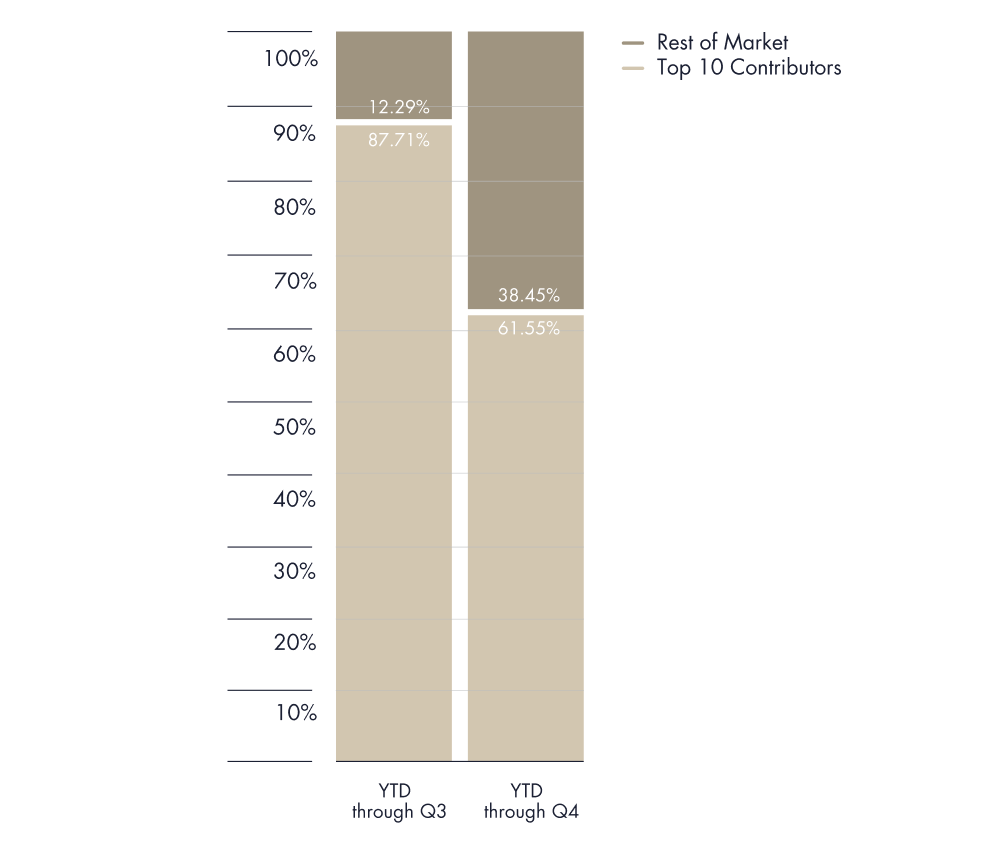
Source: Morningstar Direct.
As shown over the last quarter of the year, the concentration in returns will be less likely in 2024, emphasising the importance of stock selection and not blindly allocating to a index.
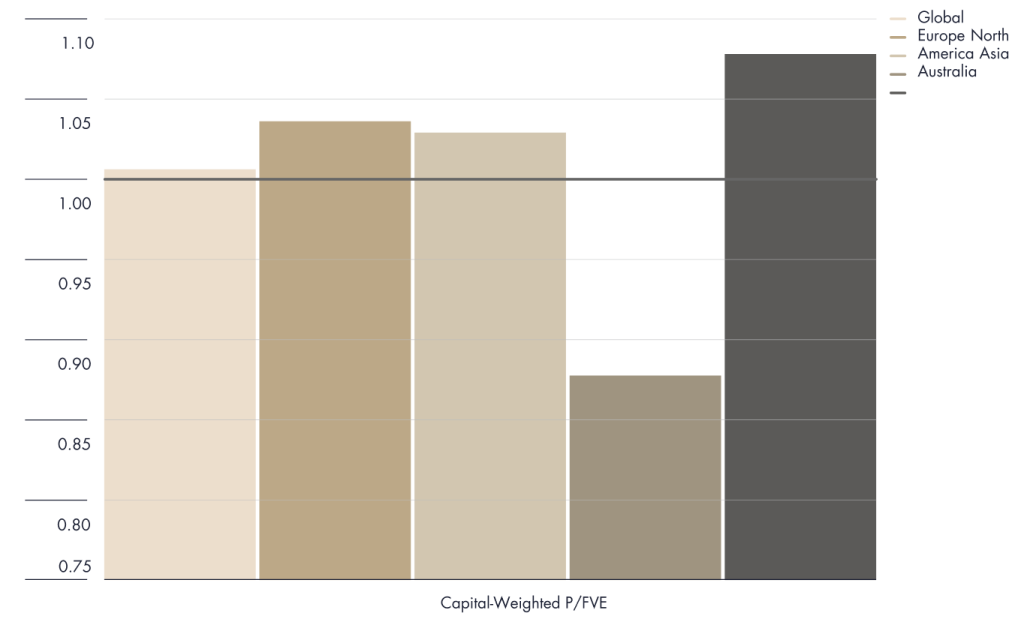
As per the image below, it is estimated that the global equity market as a whole is currently nearly fairly valued, with Asia being the only market currently trading at a discount to fair value.
CAPITAL-WEIGHTED PRICE/FAIR VALUE ESTIMATE FOR THE REGIONS
Source: Morningstar Direct.
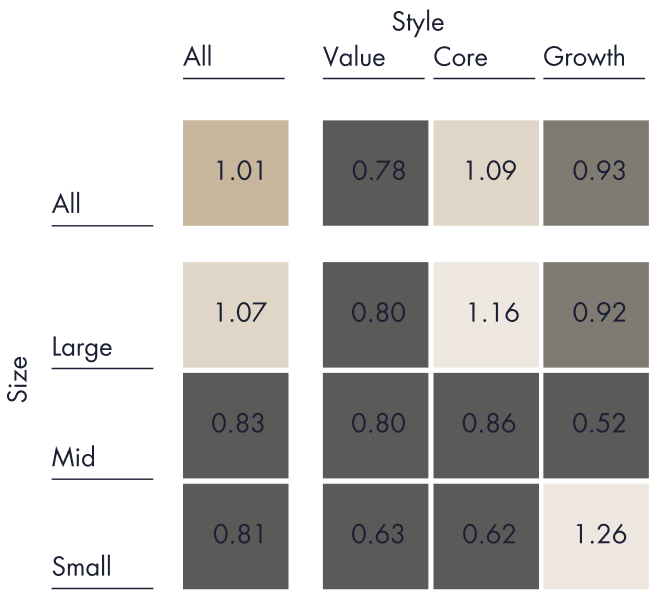
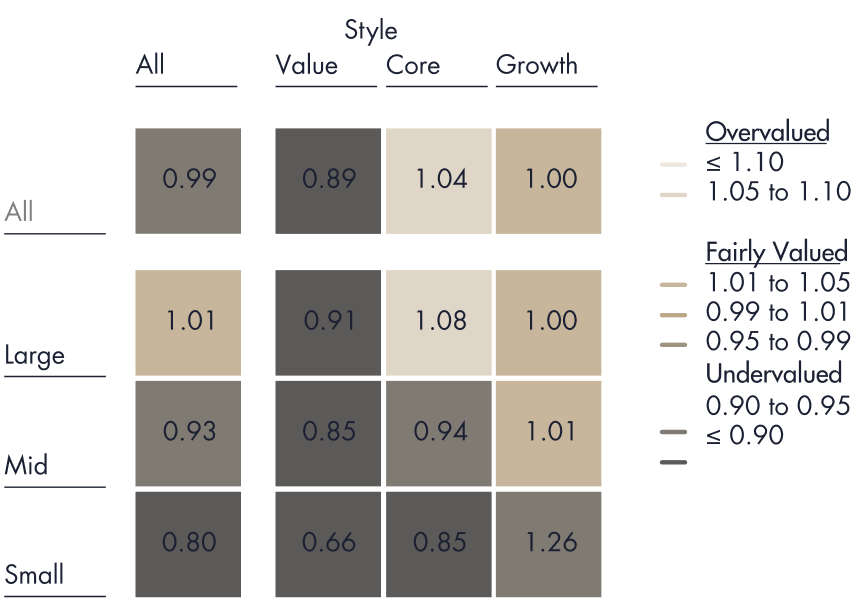
The substantial gain made by growth companies over the course of 2023, means that value and small market capitalisation companies offer more value than their large capitalisation, growth counterparts (See images below).
Source: Morningstar Direct.
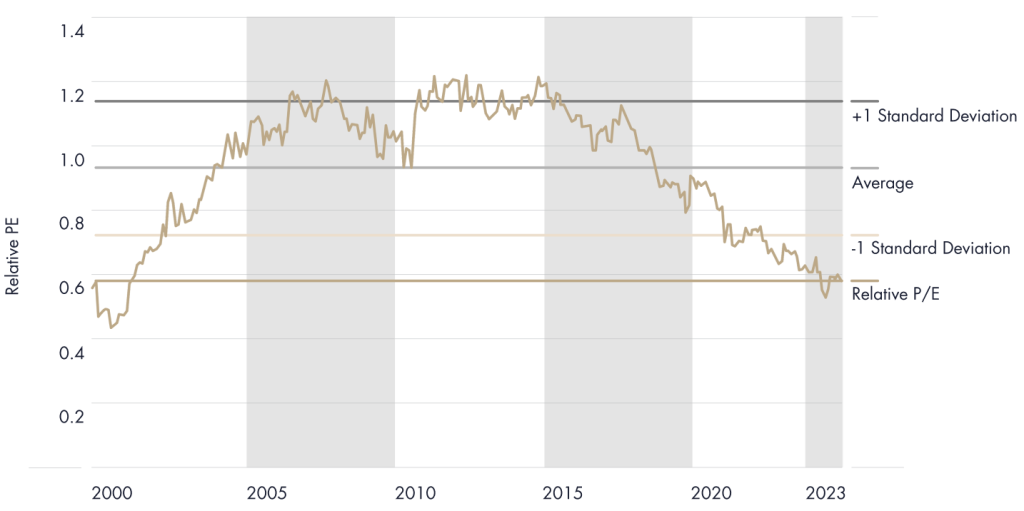
In addition, as per the graph below, small market capitalisation companies are at historically low valuation levels relative to their large market capitalisation counterparts (as measured by their relative price to earnings ratios). Therefore, although small market capitalisation companies may be more susceptible to the weakening economic conditions anticipated over the next couple of years, their currently low valuation levels present a great entry point to an asset class that historically has offered significant upside for long term investors.
RELATIVE P/E BETWEEN SMALL CAP AND LARGE CAP STOCKS
Source: Morningstar Direct.
The current high interest rate environment is yet to fully materialise on economies around the world. Even though a soft landing is anticipated, a slowdown in GDP is expected and the impact on earnings remains to be seen.
Given the current full valuations of growth companies as well as the high interest rate environment, we believe that a portfolio favouring quality, value companies would be more prudent over the course of 2024. In addition, attractive valuations present a compelling opportunity in small market capitalisation companies.
Our top picks for global equity fund that align with our outlook for 2024 include –
ARTISAN GLOBAL DISCOVERY FUND
The investment team seeks to invest in companies with franchise characteristics that are benefiting from an accelerating profit cycle and are trading at a discount to private market value. The managers typically have a portfolio comprising of 40 to 60 mid to small market capitalisation companies (no holdings may have a market capitalisation greater than 30 billion USD). We believe that their unique approach to capital allocation and security selection will provide success for investors over the long term.
LINDSELL TRAIN GLOBAL EQUITY FUND
The managers create a portfolio of 20 to 35 of their best ideas and the strict quality criteria tend to focus on a small number of industries, including consumer franchises, media, software, healthcare, and long standing domestic brands. Consumer defensives such as Unilever and Diageo have been mainstays and are among the highest conviction holdings. Areas such as materials, energy, utilities and telecommunications don’t usually meet the quality criteria. The managers almost exclusively invest in firms that they would like to own in perpetuity and the extremely low turnover supports this (averaging less than 5% per year).
ARTISAN GLOBAL VALUE FUND
Lead by the same manager since December 2007, they apply a highly refined investment approach effectively balancing quality and valuation. They create a portfolio of 40 to 60 high quality companies with financial strength and shareholder-orientated management teams that are trading about 30% below their intrinsic value estimates.
In addition, relative to their indices and peer groups both of these funds have significant overweighting to Consumer Defensive and Financial Services companies and significant underweighting to Information Technology companies. Given the current macroeconomic environment, we believe that this will pave the way to a successful 2024 for these funds.
FIXED INCOME MARKET OUTLOOK
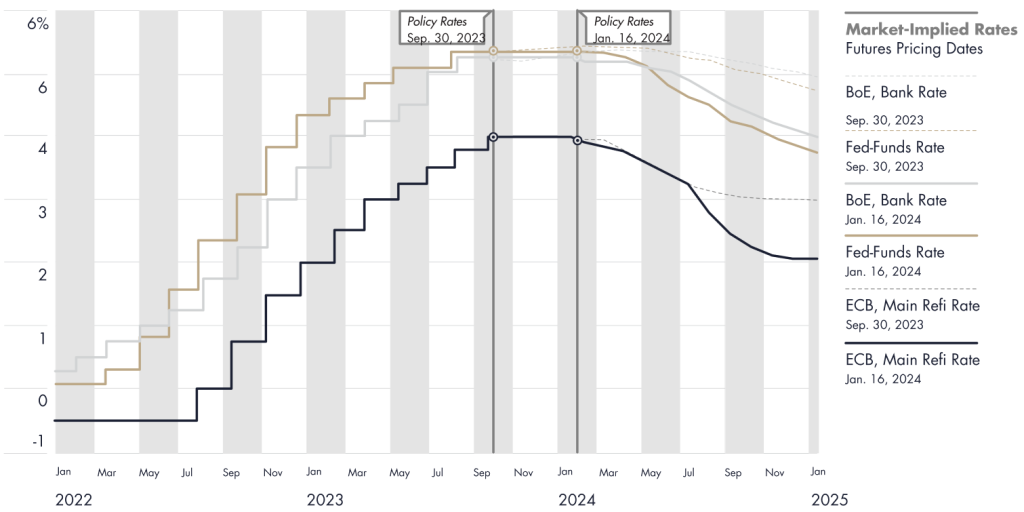
A combination of slowing economies and declining inflation will provide Central Banks the room they need to begin easing Monetary Policies over the course of 2024. As illustrated in the graph below, it is anticipated that Central Banks will pivot and begin lowering interest rates over the next couple of years.
FED,ECB, AND BOE MARKET IMPLIED PATHS OF POLICY RATES
Source: Morningstar Direct.
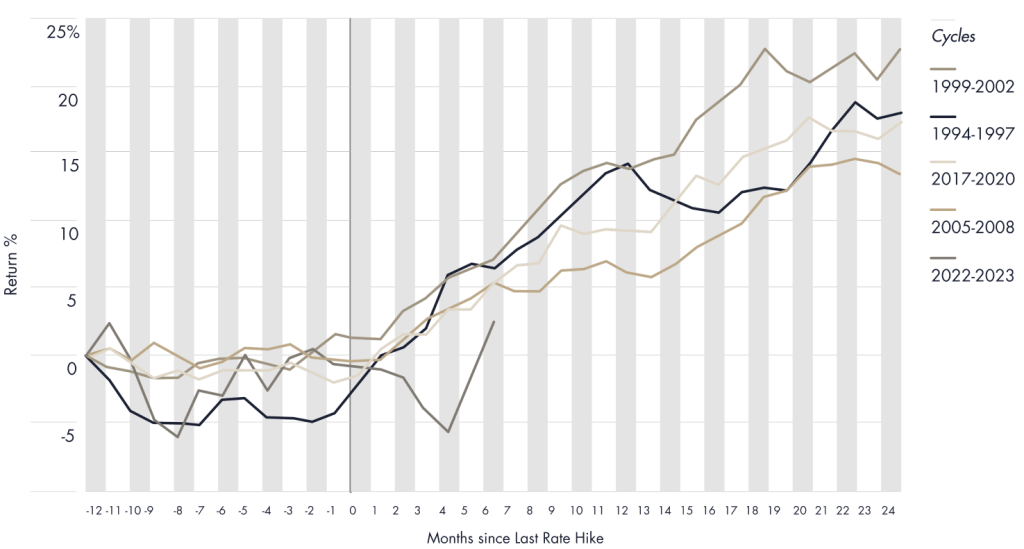
Therefore, given that interest rates are anticipated to fall over the coming years investors will be best served in longer duration bonds and locking in the currently high interest rates. As illustrated in the graph below, the two years following a peak in interest rates has been favourable for fixed income markets.
BOND MARKET RETURNS DURING HISTORICAL INTEREST RATE CYCLES
Source: Morningstar Direct.
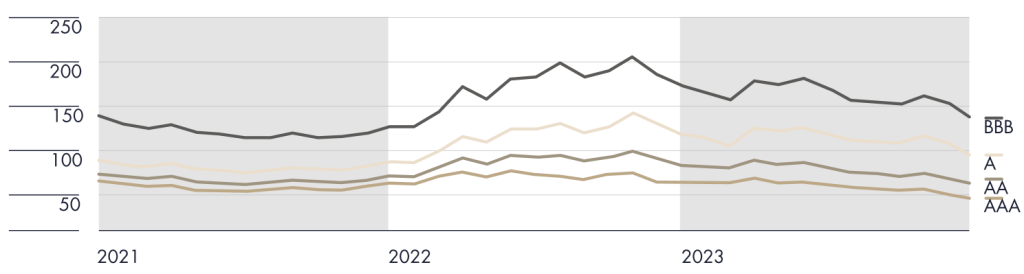
The continued resilience shown by economies resulted in corporate spreads tightening over the fourth quarter and are currently near historically low levels (See graphs below).
IG CORPORATE BOND OAS, TRAILING 3-YEAR (2021-2023)
Source: Morningstar Direct.
HIGH-YIELD CORPORATE BOND OAS, TRAILING 3-YEAR (2021-2023)

Source: Morningstar Direct.
A prolonged period of high interest rates would be unfavourable for corporates and given the uncertainty on when Central Banks will pivot their policies, we believe that favouring bonds with less credit risk would be prudent. In addition, we believe that the aggressive interest rate hiking cycles by Central Banks will have more of a negative impact on economies than currently being witnessed.
Based upon our outlook for fixed income markets for 2024 our top pick is –
BRANDYWINE GLOBAL OPPORTUNISTIC FIXED INCOME FUND
For over two decades the Brandywine team has offered investors compelling returns and managed to consistently outperform its benchmark namely, the World Government Bond Index. The Global Opportunistic Fixed Income strategy seeks global bond investments offering the best combination, in their view, of high real yield and attractive fundamentals given their macroeconomic outlook. This value-based strategy maintains a primary focus on sovereign debt with a goal of unlocking the potential performance benefits of mean-reversion tendencies in interest rates and currency valuations.
Relative to its peer group and benchmark the fund currently has significantly longer duration and higher credit quality, two important characteristics that we believe will make this fund a compelling investment option over the next couple of years.
REAL ESTATE MARKET OUTLOOK
Optimism around a shift in Monetary Policy sparked a significant rally in the real estate market over the fourth quarter as rates shifted lower on the longer end of the yield curve.
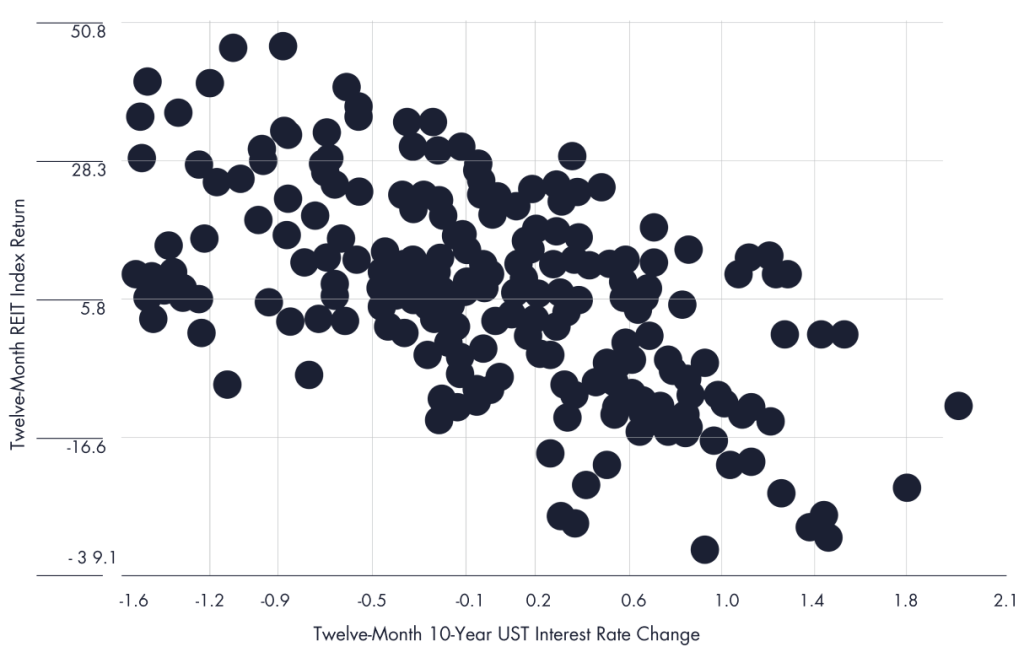
As indicated in the graph below, interest rates and the performance of the real estate (as indicated by the REIT Sector) have shown to be negatively correlated, meaning that a decline in interest rates will be positive for property investments.
RELATIVE PERFORMANCE OF REIT SECTOR NEGATIVELY CORRELATED WITH INTEREST RATES
Source: Morningstar Direct.
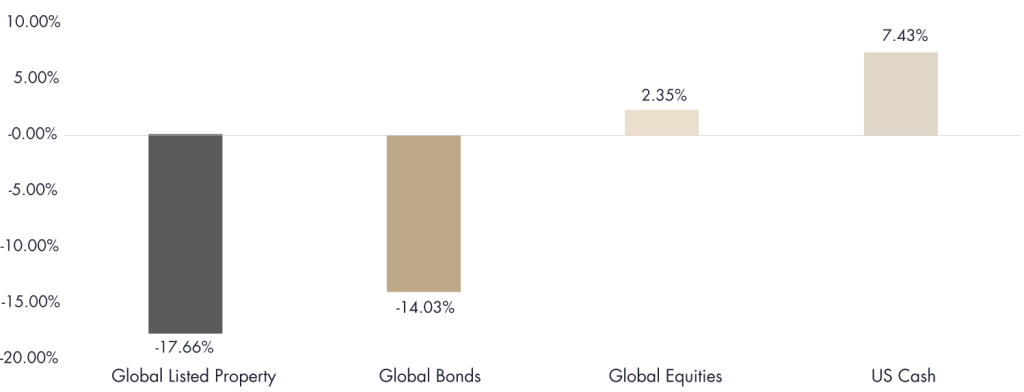
The graph below shows the relative performance of asset classes over the past couple of years. It is clear that Fixed Income and particularly Real Estate, have had a tough couple of years as a result of the dramatic tightening of Monetary Policies undertaken by Central Banks.
ASSET CLASS PERFORMANCE (CUMULATIVE RETURNS IN USD) 1 JAN 2022 – 31 DEC 2023
Source: Catalyst Fund Managers & Bloomberg Data
However, in spite of the divergence in performance of Real Estate relative to other asset classes over the past couple of years, it still remains the top performing asset class over the past twenty-five years (See graph below).
ASSET CLASS PERFORMANCE (ANNUALISED RETURNS IN USD) 25 YEARS

Source: Catalyst Fund Managers & Bloomberg Data.
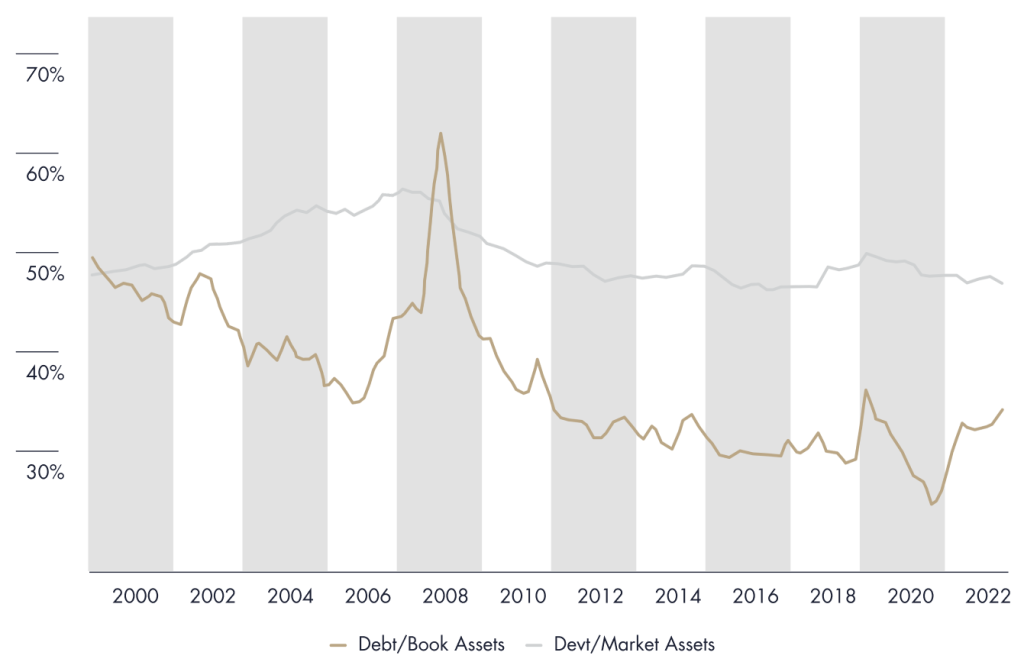
Taking a closer look at the fundamentals of REITs, it is clear that they are currently well positioned to navigate economic uncertainty in 2024. This is indicated by their current favourably low levels of debt as reflected in the graph below, Debt to Book Assets around 50% and Debt to Market Assets around 35%.
REITs BALANCE SHEETS
Source: NAREIT T-Tracker.
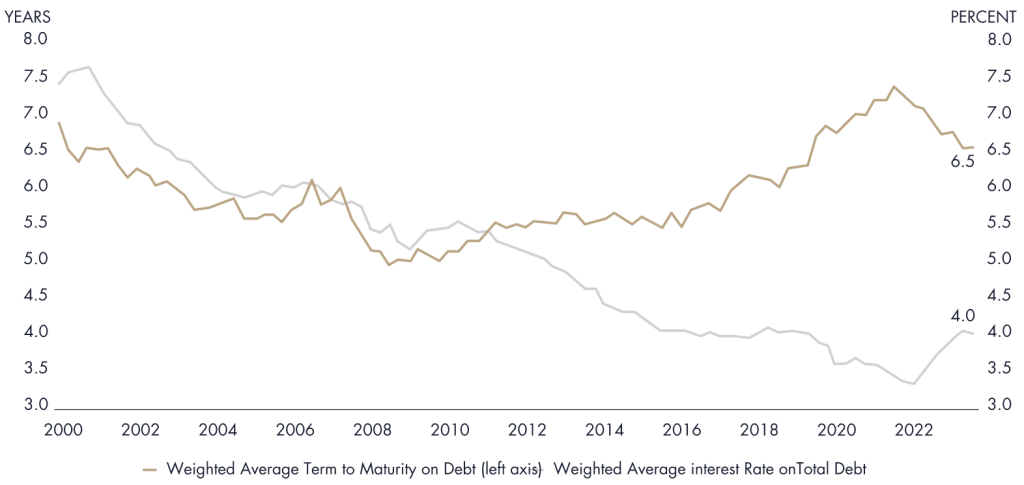
In addition, REITs currently have a long weighted average time to maturity on debt as well as a relatively low weighted average interest rate on their total debt. Given, the longer maturity of debt and current low average interest rates, it clear that REITs have remained relatively unaffected by the significant tightening of Monetary Policies and are well positioned to navigate the current economic environment.
REIT DEBT IS WELL TERMED
Source: NAREIT T-Tracker.
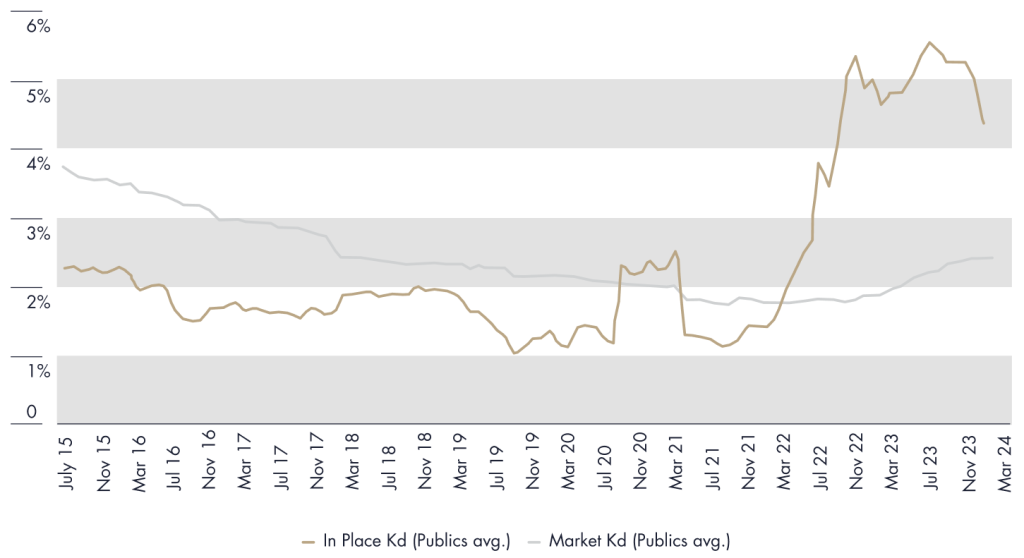
Furthermore, as illustrated in the graph below, REITs in general have been relatively insensitive to interest rate changes with a large divergence in the average interest rate in place and the average interest rate available in the market. Therefore, the impact of interest rate changes on earnings will likely be less than the market currently anticipates.
IN-PLACE & MARKET AVG. COST OF DEBT (EUROPEAN REITs)
Source: GreenStreet Advisors.
Based upon the above it is clear that –
- Real Estate is currently attractively valued, after a difficult two years;
- REITs currently have strong fundamentals which will allow them to navigate economic uncertainty with relative ease;
- The impact of interest rate changes on earnings will be less than the market has anticipated; and
- When the shift in Monetary Policy arises it will provide a significant tailwind for investors.
Therefore, we believe that Real Estate is currently offering attractive opportunities for investors that cannot be ignored.
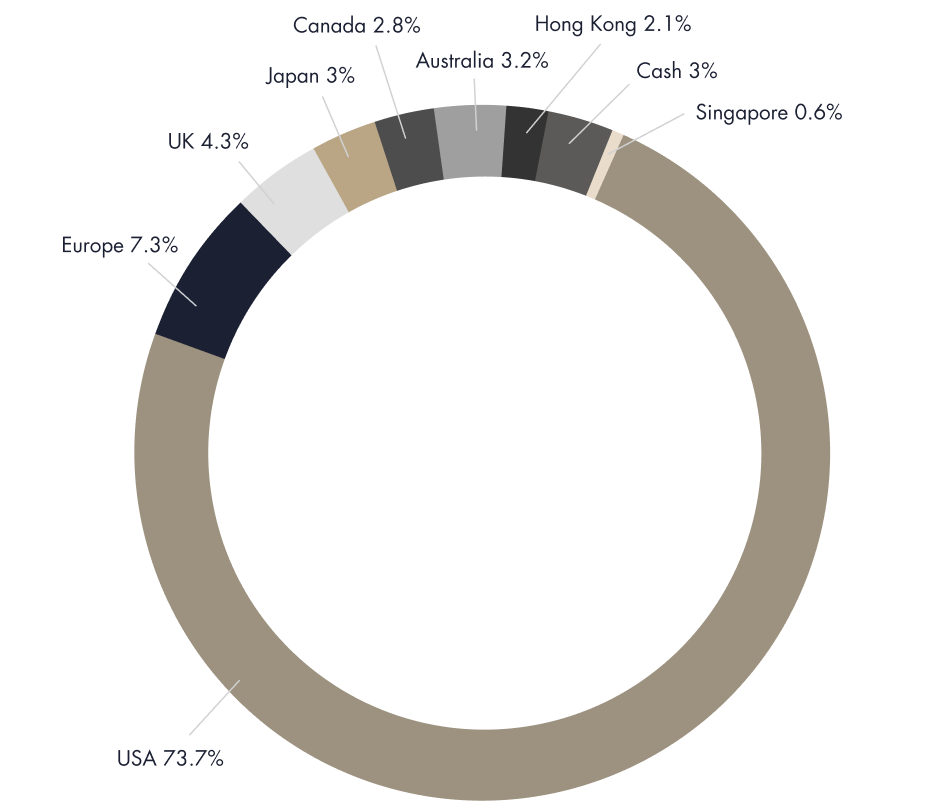
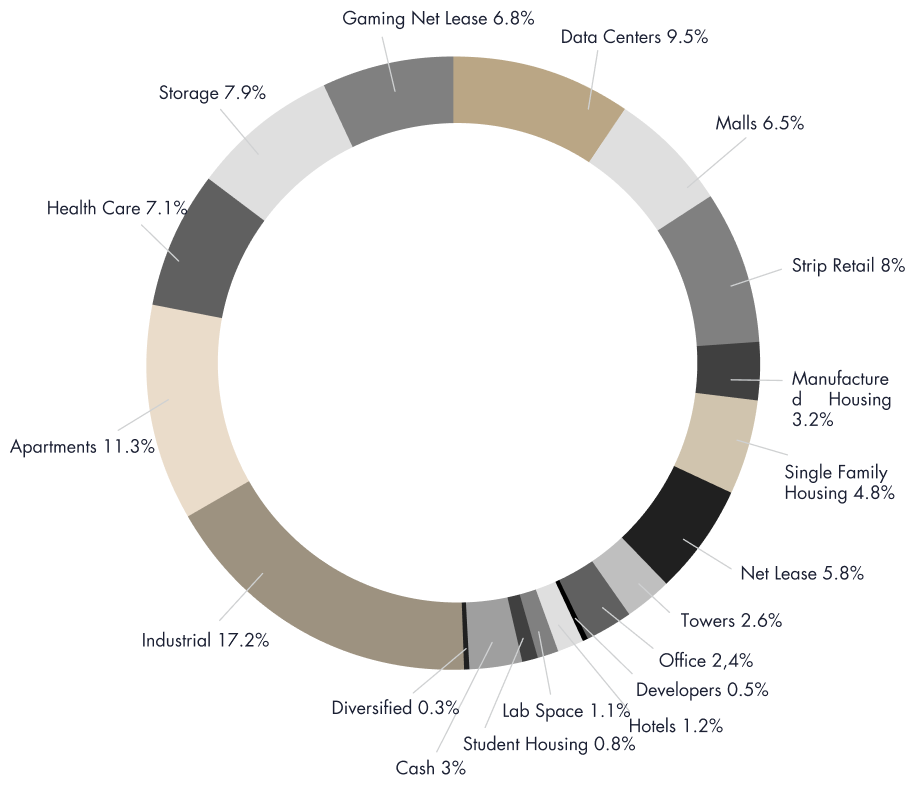
Our property fund manager of choice remains Catalyst Fund Managers who over the past 22 years have continued to produce benchmark beating returns for their investors. Catalyst are property specialists, who utilise bottom-up, fundamental research to develop diversified global real estate portfolios. Their unrivalled, in depth knowledge of real estate markets continues to provide significant value to our clients’ portfolios. Lastly, their portfolio offers significant geographical and sectoral diversification (see graphs below) which indicates the expertise required to navigate and identify areas of value in a very nuanced asset class.
FUNDʼS GEOGRAPHIC ALLOCATION
Source: Catalyst Fund Managers.
FUNDʼS SECTORAL ALOOCATION
Source: Catalyst Fund Managers.
CONCLUSION
The current high interest rate environment and the eventual shift in Monetary Policy from Central Banks will present opportunities and prudent investors must position their portfolios accordingly. A change in interest rate environment will be particularly appealing for Fixed Income and Real Estate assets which will provide a favourable return to risk trade-off after a difficult couple of years.
