



PORTFOLIO CONSTRUCTION – COMPLEXITY DOES NOT ALWAYS EQUATE TO SUCCESS
The medical field has made monumental improvements and innovations over the past hundred years. Not that long ago the lobotomy was being used to alleviate the pain and distress of the mentally and emotionally ill, heroin was introduced as a safe non-addictive substitute for morphine and marketed towards children suffering from sore throats, coughs and colds, and cocaine was marketed as a treatment for toothaches, depression, sinusitis and lethargy. Sadly, the wealthiest of individuals often had the worst overall health. Their wealth was a blessing and a curse, being able to afford the latest treatment for an ailment was potentially life threatening. The same can be said for the financial advice received by wealthy families today. They are often lured into a false sense of security by overly complex solutions that more often than not erode alpha. True complexity lies in understanding and appreciating simplicity and we at Bellamont Wealth believe that when it comes to building bespoke portfolios for our clients, more often than not the simplest solution is the best. The below article outlines the shortcomings of conventional approaches to asset allocation and highlights the Bellamont approach to portfolio construction.
“All models are wrong but some are useful.” – George E.P. Box
Mean-Variance Optimization (MVO), also known as Modern Portfolio Theory (MPT), was developed by Harry Markowitz in the 1950s and has been a fundamental concept in portfolio construction. MVO aims to find the optimal allocation of assets in a portfolio by balancing the trade-off between expected returns and risk (volatility). Whilst MVO was revolutionary, it has some inherent flaws and portfolio construction based upon solely what MVO deems as optimal will likely to lead to an inefficient outcome for investors. We believe in a more balanced approach to portfolio construction whereby reliance on a single model or data source is avoided and inherent flaws are understood. Some of the inherent flaws to MVO are discussed below, including, the delusion of forecasting, sensitivity of optimisation to return assumptions as well as the irrelevance of optimising according to return relative to a measure of risk (volatility).
DELUSION OF FORECASTING
“Prediction is difficult, particularly when it involves the future” – Mark Twain.
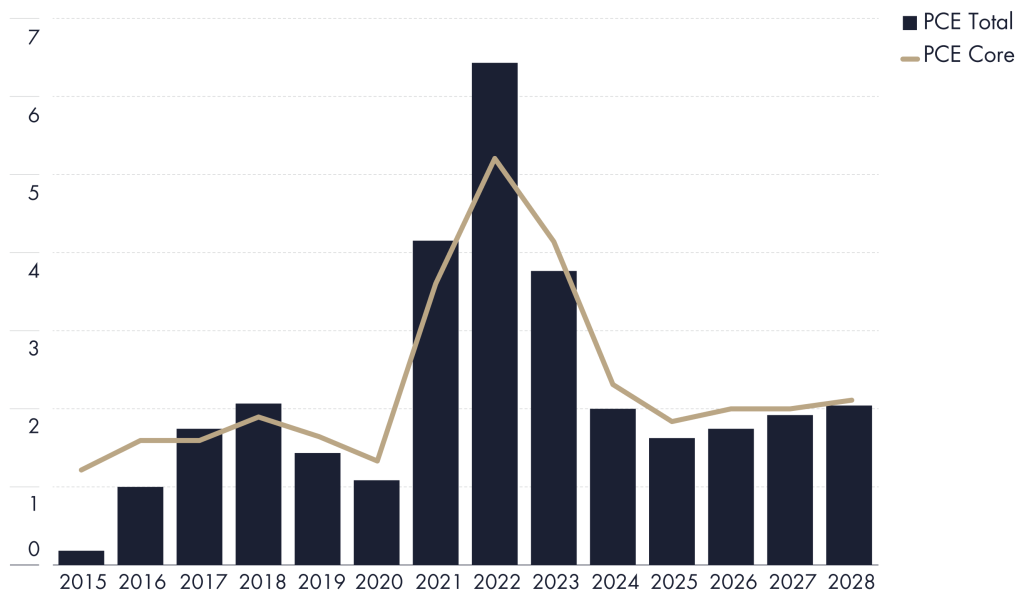
In 2021, 16 of the 36 living American Nobel economists predicted that the United States’ government stimulus would pose no threat to inflation. Fast forward to June 2022, The Personal Consumption Expenditures Price Index, or PCE Index (the Federal Reserve’s preferred inflation measure) was peaking at 7.0% year over year growth (see graph below), a far cry from historical averages.
PCE INFLATION (%)
Source: Morningstar Direct.
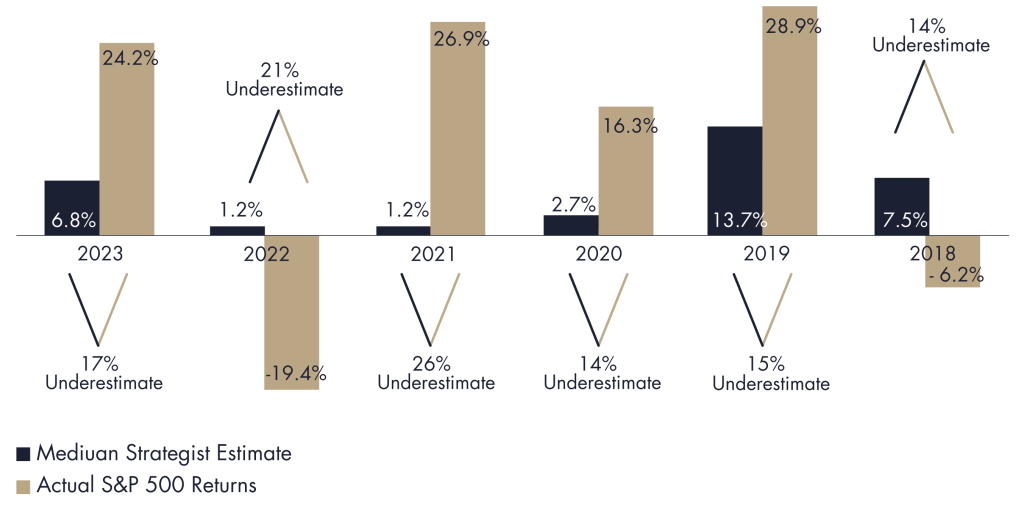
Recently, 70% of economists polled by Bloomberg anticipated a recession in the United States in 2023. In addition, another poll from the National Association for Business Economics (NABE), found that 58% of economists believed there was a more than 50% chance of the United States entering a recession over the course of 2023. However, the reality is that Real GDP growth in the United States for 2023 is predicted to be 2.5%, with the GDP growth rate in the third quarter (4.9%) rivalling some of the strongest post-war periods in American history.
CONSENSUS S&P 500 ESTIMATE VS ACTUAL RETURNS (2018 – 2023)
Source: Morningstar Direct.
Predicting market movements is an impossible task and as indicated above, time and time again there have been large deviations between forecasts and reality. MVO and its successful application is inherently dependent upon the accuracy of forecasting expected returns, with large deviations in allocations resulting from small changes in expected returns. As an indication, portfolio optimisation is about 10 times more sensitive to the return assumptions than the volatility assumptions and about 100 times more sensitive to the return assumptions than the correlation assumptions. In practice, returns are much harder to predict than volatility or correlation, and the estimation errors associated with return forecasts are so large that it is estimated that thousands of years of data would be needed to reliably calculate the optimal portfolio in practice and outperform an equally weighted portfolio. Most optimisation models are generated using only 60 to 120 months of data and various extensions to MVO only moderately reduce the estimation window needed to outperform an equally weighted portfolio.
However, the principles of MVO are not irrelevant as it does inform us that combining assets with less than perfect correlations will improve a portfolio’s return or achieve the same return with a lower level of volatility. Therefore, the issue is the pursuit of a mythical optimal portfolio, that in reality is unlikely to come into fruition and the greater the number of assets, the increased likelihood of underperformance to an equally weighted portfolio. Bellamont believes in applying the core principles of MVO but understand that little good can come from continuously optimising over limited datasets.
IRRELEVANCE OF MAXIMISING RETURN TO VOLATILITY
MVO and optimising a return for a given level of volatility often lures investors into a false sense of security, when in reality the unobservable metrics such as behavioural biases are the most costly to investment success. Tactically allocating a portfolio in pursuit of a more efficient risk, return trade-off can be detrimental to wealth creation. We believe in ensuring that investors understand their long term investment objectives and behave accordingly in the present. In addition, we present the importance of Maximum Drawdown (MDD) as a measure risk as opposed to volatility.
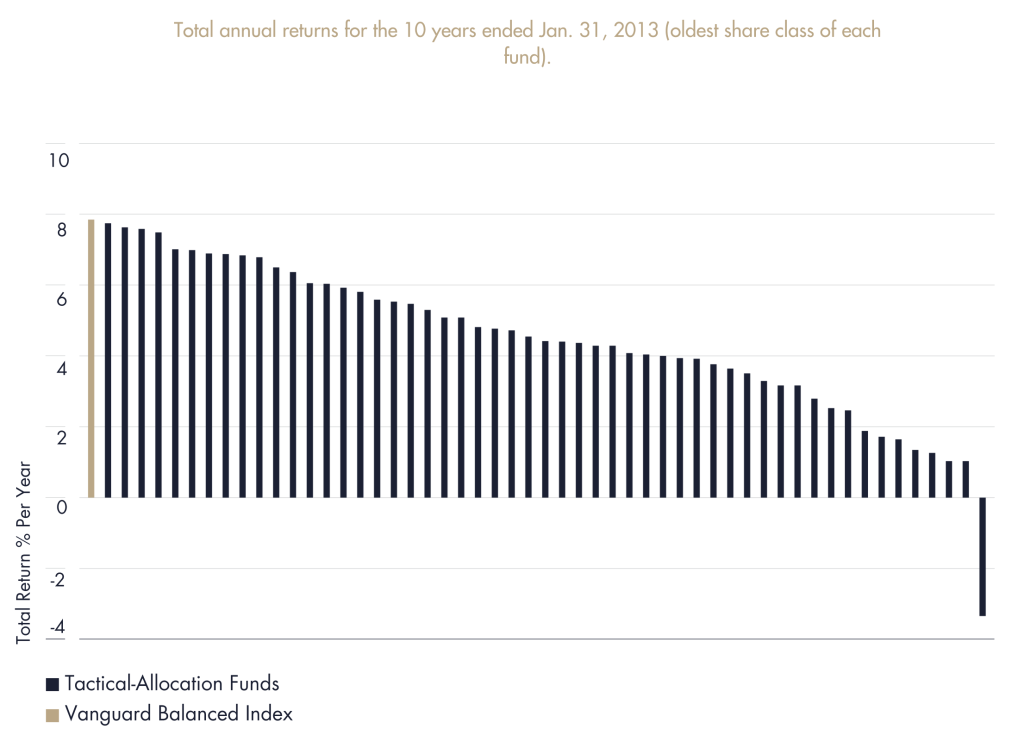
Tactical asset allocation is an investment strategy that involves actively adjusting a portfolio’s asset allocation based on short to medium term market conditions and economic forecasts. Unlike strategic asset allocation, which is based on a long-term target mix of asset classes, tactical asset allocation aims to capitalise on perceived market opportunities or mitigate risks by making dynamic changes to the portfolio. Whilst this sounds good in theory as Albert Einstein said, “In theory, there is no difference between theory and practice, while in practice there is.” Adjusting allocations according to expectations of short term market movements, would likely require perfect foresight to successfully implement and hindsight informs us that continually shifting allocations does not bear fruit for investors. In an ideal world, we’d ratchet our asset exposures up and down in anticipating market gyrations, bagging gains and sidestepping losses. The world doesn’t work that way though, as reflected in the graph below, not a single tactical fund managed to outperform a 60% US Equity, 40% US Bonds portfolios over a trailing 10 year period ending on the 31st of January 2023.
VANGUARD BALANCED INDEX’S PERFORMANCE VS ALL FUNDS IN THE TACTICAL ALLOCATION MORNINGSTAR CATEGORY
Source: Morningstar Direct.
The above example highlights how remaining aligned with your long term investment strategy is perhaps one of the most crucial elements in achieving investment success and continually repositioning a portfolio under the guise of optimisation more often than not will yield little positive results. We believe in ensuring that investors’ portfolios are aligned with their long term investment objectives and view risk in terms of the inability to meet investment objectives and not short term market movements as measured by volatility.
Maximum Drawdown (MDD) is a key metric used in finance to assess the risk and performance of an investment or a trading strategy. It represents the maximum percentage decline in the value of a portfolio or an investment from its peak to its trough over a specified period, before a new peak is reached. In simpler terms, maximum drawdown measures the largest loss an investment or portfolio has experienced relative to its previous highest value. Maximum drawdown is a crucial measure as it has been positively linked to outperformance and has a certain degree of predictive power as a manager’s maximum drawdown persists as it is largely dependent upon philosophy and methodology which are relatively static in nature.
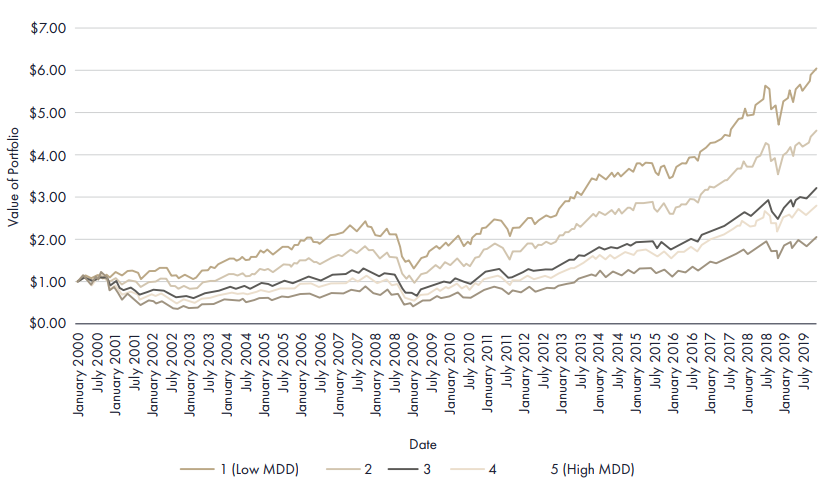
The graph below illustrates the changing value of a $1 investment made in five different portfolios from January 2000 to December 2019. The portfolios are comprised from a sample of 2,188 actively managed American mutual funds. The portfolios are equal weighted, monthly rebalanced, and formed by sorting the top 20% performing funds according to their maximum drawdown. The “Low MDD” portfolio consists of the funds in the lowest 20% of past maximum drawdown. The “High MDD” portfolio consists of the funds in the highest 20% of past maximum drawdown. The value of minimising your maximum drawdown is evident as amongst the top performing funds, the funds with the lowest past maximum drawdown outperformed those with the highest maximum drawdown by 2.40% per year over the study period.
THE CHANGING VALUE OF A $1 INVESTMENT MADE IN FIVE DIFFERENT PORTFOLIOS FROM JANUARY 2000 TO DECEMBER 2019
Source: CFA Institute Financial Analysts Journal.
At Bellamont we ensure that our chosen fund managers invest in quality assets, that can compound over time and have a certain degree of predictability in their earnings. These qualities limit upside or downside surprises and when aggregated at a portfolio level, will translate into a lower maximum drawdown, which as indicated above should result in alpha over the long term.
BELLAMONT APPROACH
Investment management is an inherently complicated process and models which form the bedrock of the investment industry are based upon simplifying assumptions which allow for the demonstration of core principles. The issue lies in applying these models to the real world, as we cannot create a vacuum for our models to exist, absent from the reality of the world.
Blindly applying models to the real world, will likely erode alpha and lead to inefficient outcomes. Therefore, we believe in and apply the core principle of MVO, which is that a combination of assets with less than perfect correlations, will deliver a more efficient outcome for investors, but steer clear of tactically allocating, to align with a believed optimal portfolio. In addition, we prefer to focus on maximum drawdown and assisting in controlling behavioural biases which may prevent investors to remain aligned with their long-term investment objectives. These are both salient measures, as opposed to maximising return subject to volatility, which if accounted for, should deliver alpha for investors over their investment horizons.
