



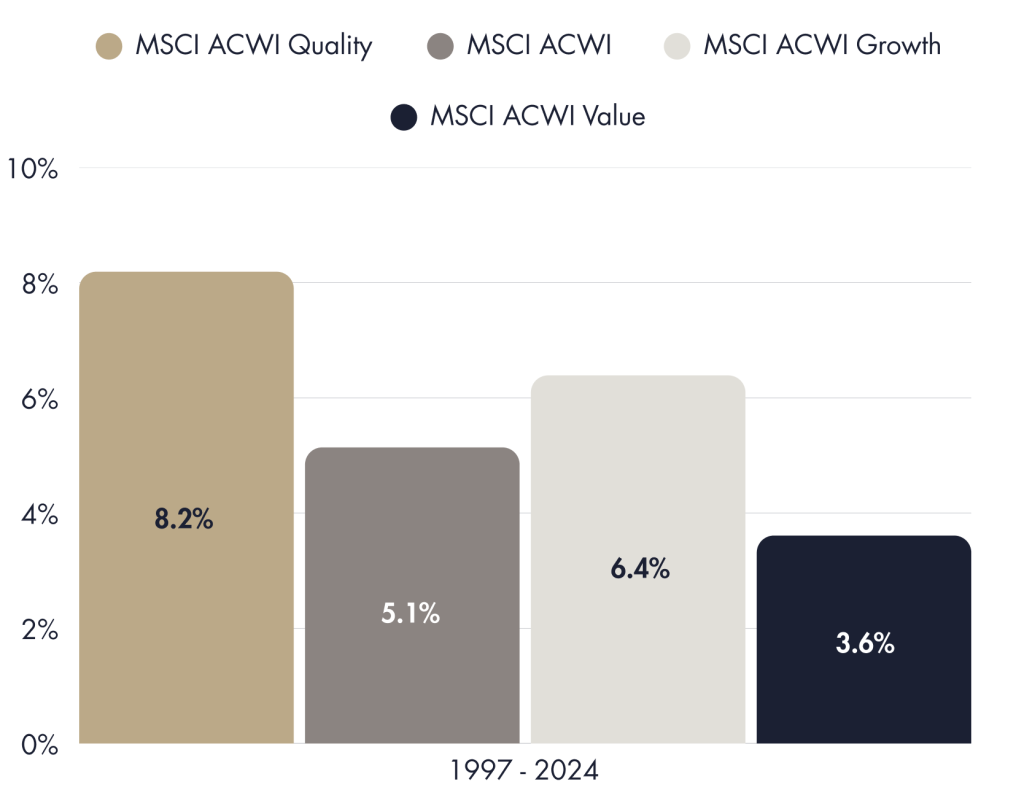
Source: MSCI. Data as at 30 June 2024. Reflected in USD.
This focus on excellence can be likened to the meticulous engineering and strategic planning seen in Formula 1 racing. Success in F1 is not merely about speed; it involves precision and an unwavering commitment to quality. Teams like Mercedes and Ferrari consistently perform at the top due to their dedication to quality in every aspect of their operations. Every component of the car, every pit stop, and every strategy is refined to perfection. Similarly, quality companies excel due to their strong corporate governance and efficient management, leading to better risk management practices and more predictable earnings and cash flows.
PREDICTABILITY
While value and growth investing have their merits, they can be unpredictable. Value stocks may remain undervalued for extended periods, and growth stocks, though promising high returns, can be excessively volatile. In contrast, quality investing provides a balanced approach. It does not rely solely on market sentiments or speculative growth prospects but on tangible, measurable metrics that indicate a company’s health and sustainability.
Consider the resilience of quality stocks during market corrections. During the 2008 financial crisis, companies with strong balance sheets and stable earnings, such as Johnson & Johnson and Procter & Gamble, experienced less severe declines compared to highly leveraged or speculative firms. This stability is a testament to the predictability and robustness of quality investing. This approach is akin to the consistency seen in the training and performance of tennis legends like Roger Federer and Serena Williams. Their success is not just due to raw talent but also a result of rigorous training regimens, attention to detail, and a focus on continuous improvement. Federer’s graceful backhand and Williams’ powerful serve are not just natural gifts; they are the results of countless hours of practice and refinement, mirroring the core tenets of quality investing.
PROTECTION AGAINST INFLATION
One of the standout benefits of quality investing is its ability to protect against inflation. Quality companies often have pricing power, allowing them to pass increased costs onto consumers without significantly impacting demand. This helps maintain profit margins even in inflationary environments. The table below reflects this, as in the last twelve years where there has been elevated levels of inflation in America—as indicated by annualised CPI greater than 3%—quality companies have outperformed the broad developed market (which America constitutes over 70%).

Source: MSCI & FRED. Data as at 30 June 2024. Reflected in USD.
A notable example is the performance of consumer staples and healthcare companies, which are often considered quality investments. These sectors have shown resilience during inflationary periods due to their essential nature and consistent demand. Warren Buffett, a famous quality investor and staunch advocate of this strategy, highlighted the importance of investing in companies like Coca-Cola and American Express, which possess strong brand loyalty and pricing power. Coca-Cola’s ability to maintain consumer loyalty through brand strength and consistent product quality allows it to adjust prices in response to inflation without losing market share, much like a seasoned chef who maintains the quality of his dishes regardless of fluctuations in ingredient costs.
CONCLUSION
The above article sheds light on the power of quality investing and how placing a preference on quality attributes has translated to superior long-term risk-adjusted returns for patient investors. Patience is the key to unlocking the superior returns in quality companies, and investors need to be diligent in their application as repeatable missteps will erode potential alpha. As Aristotle wisely noted, “Quality is not an act, it is a habit,” and we at Bellamont ensure that our clients’ portfolios are rooted in quality across time—something that we believe will translate to investment success.
