



INTRODUCTION
Risk is a fundamental element of investing, therefore, understanding it and measuring it appropriately is crucial in defining and achieving investment success. The below article highlights the basics and importance of risk as well as determining the appropriate level of risk in a portfolio.
THE BASICS OF RISK
Everyone is exposed to some type of risk every day, whether it’s from driving, walking down the street, investing, capital planning, or something else. An investor’s personality, lifestyle, and age are some of the most important factors to consider for individual investment management and risk purposes. Each investor has a unique risk profile that determines their willingness and ability to withstand risk. In general, as investment risks rise, investors expect higher returns to compensate for taking those risks.
The most widely used metric to measure risk is standard deviation. The standard deviation of dataset is a measure of the magnitude of deviations between the values of the observations. A high (low) standard deviation indicates a large (small) amount of volatility and therefore a larger (smaller) amount of risk.
RISK VS REWARD
The risk-return trade-off is the balance between the desire for the lowest possible risk and the highest possible returns. In general, low levels of risk are associated with low potential returns and high levels of risk are associated with high potential returns. The chart below illustrates the typical risk/return trade-off in investing whereby higher (lower) levels of risk result in higher (lower) returns.
RISK/RETURN TRADEOFF
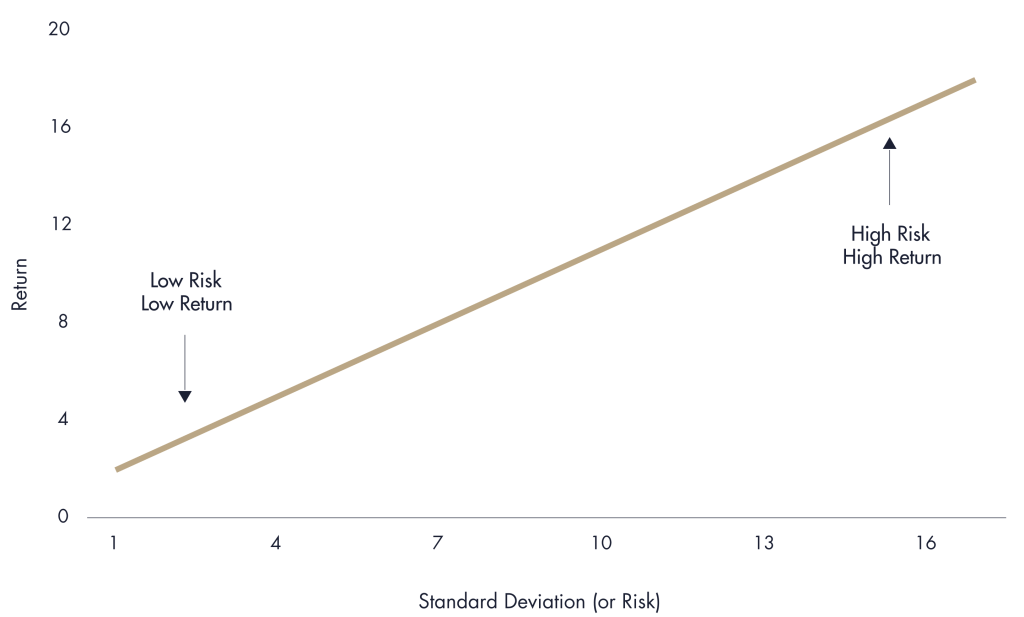
It’s important to keep in mind that higher risk doesn’t automatically equate to higher returns, the above graph is an illustration of the typical risk/return relationship. A higher level of risk increases the possibility of greater returns but does not guarantee it.
WHAT AFFECTS THE LEVEL OF RISK YOU SHOULD TAKE?
The amount of risk undertaken is unique to each investor and is based upon the following factors –
Investment Goals – The nature of investment goals will impact the willingness and ability to undertake risk. The more (less) certainty required and immediate the investment goal, the less (more) risk that can be undertaken.
Investment Timeframe – Generally the longer the investment horizon, the greater the capacity to bear risk. A longer investment horizon enables investors to withstand market downturns and periods of heightened market volatility and not force liquidation at inopportune moments when market values are suppressed.
Other Assets Held – An investor’s portfolio should be examined from a total wealth perspective, as assets held outside of the investment portfolio could substantially alter its ability to bear risk. Risk needs to be balanced from a total portfolio perspective and the more (less) concentrated risk factors are outside the investment portfolio the lower (higher) the risk capacity.
Capacity for Loss – The capacity for loss is based upon the relative size of an investors portfolio in relation to their required drawdown from their portfolio. The larger (smaller) the portfolio in relation to the required drawdown, the greater (lower) the ability to undertake risk.
Risk Perception – An investors subjective opinion about risk is another factor integral in determining the appropriate level of risk that an investors portfolio should contain. It is important for investors to be comfortable with the investment decisions made, which is influenced by their perception of risk, the greater (lower) their perceived level of risk the lower (greater) the ability to bear risk.
These factors collectively are key determinants in the level of risk that a portfolio and investor is willing and able to bear.
UNDERSTANDING THE IMPORTANCE OF RISK
In order to properly understand risk it is important to make the distinction between short term volatility risk, that is the day to day movements in portfolio values and shortfall risk, the risk that a portfolio is insufficient in providing for drawdown requirements. Investors are faced with these two risks to varying degrees and the key to successful investing is learning to balance these two risks and understanding how much short term volatility is required to provide for long term investment objectives.
Investors tend to focus on short term volatility and as a result of short term market gyrations they often feel that they can’t control or moderate their investment risk. However, the reality is that volatility is often just noise, reflecting worries that won’t have any lasting or appreciable effect on a company’s operations. In these cases, volatility risk should not leave the realm of paper losses.
Investors should rather focus on shortfall risk and the ability of their portfolio to provide for their long term investment objectives, not market movements today, next week or next year. Shifting focus appropriately to the long term will allow investors to realise that exposure to short term market volatility and risk is necessary to generate the return required to provide for their long term investment objectives.
However, as highlighted above it is important to note that the longer the investment horizon, the greater the ability to bear risk. Therefore, the shorter the investment horizon, the more the investors focus should shift from shortfall risk to short term volatility. This is as a result of the fact that the shorter the investment horizon, the less time available to ride out periods of volatility and the increased likelihood of having to exit positions at unfavourable prices.
Standard deviation as highlighted above is the most widely used risk measure in the investment management industry. However, we at Bellamont Wealth Management believe that the longer the investment horizon the less important standard deviation becomes as a measure of risk. Gauging risk through daily price movements becomes irrelevant over an investment horizon that spans multiple decades. We believe that emphasis should rather be placed on the risk of permanent capital loss and shortfall risk as measures of risk. Often investors can be lured into a false sense of security by having portfolios that minimise standard deviation but in reality have magnified risks of permanent capital loss and have insufficient capital to provide for their objectives. In order to hedge these risks our investment philosophy is based upon consistently applying an appropriately rigid approach to asset allocation that focuses on ensuring that capital is allocated to quality companies that can compound over long periods of time.
CONCLUSION
Risk is an inherent part of investing and it is important to understand when it is appropriate to emphasize short term volatility or shortfall risk. Albert Einstein once said that “If you judge a fish by its ability to climb a tree, it will live its whole life believing that it is stupid.” Therefore, in order to avoid judging a fish on its ability to climb a tree, a clear understanding of a portfolio’s investment objective as well as time horizon is imperative.
